The eucalyptus honey that I have is from Olivera do Hospital in Portugal.
Oliveira do Hospital is a municipality in the central part of continental Portugal in the district of Coimbra, which is known for, among other things, as having one of the oldest universities in Europe, the University of Coimbra (founded in 1308). The area has been inhabited since at least 465 BCE, first by the Romans, and later by the Visigoths, Moors, and Christians. Coimbra also has the distinction of being named the capitol of the new Kingdom (aka Portugal) in the mid-12th century by the first Portuguese King, Afonso Henriques.
Olivera do Hospital, which is located on the northern edge of the district of Coimbra, is home to about 5,000 inhabitants. It is an agricultural area known primarily for its wine and cheeses, located in the foothills of the Serra da Estrela Mountains, which are bisected by the Alva and Alvoco River valleys. They also make honey.
The producers of my eucalyptus honey, Quinta de Jugais (http://www.jugais.com) produce other types of honey (mountain, rosemary, orange, heather), as well as jams, olive oil, and tea. Their website states that they pride themselves in using traditional methods that produce high-quality products.
According to Wiki, 'Eucalyptus' comprises a diverse genus of flowering trees in the myrtle family, Myrtaceae. There are more than 700 species of Eucalyptus, but most are native only to Australia, with only 15 species found in other areas. Eucalyptus trees are cultivated throughout the tropics and subtropics. Some Eucalyptus species are of interest to environmentalists because they are fast-growing sources of wood, produce oil that has natural insecticide qualities, and, can be used to drain swamps (given their 'water sucking' ability), thereby reduce the risk of malaria.
Eucalyptus honey is a hearty orange-red color with a slightly spicy aroma. It is a relatively thick honey with a surprisingly simple taste, of honey sweetness with a subtle under and after taste of something herby, not unlike green tea. The taste is clean and stable throughout. Because the taste is not overpowering or complex, I think it would be a good choice for baking or in tea.
I got my Qinta de Jugais eucalyptus honey at TJMAXX (of all places) but I see that on their website you are able to contact the producers so might find sellers in your area by contacting them.
Search This Blog
Sunday, February 5, 2012
Sunday, January 29, 2012
Star Thistle (Centaurée) Honey, Maria, Gaspésie, Québec, Canada
This honey is from the Gaspésie, a peninsula running along the south shore of the Lawrence river at the Eastern most tip of Quebéc, Canada. The shore bordering the river is made up of sea cliffs, and the interior of the peninsula is rugged, mountain country containing the Chic-Chocks mountains (a northern continuation of the Appalachian mountains). The interior region, which is mostly covered by coniferous forests, offers some of the most rugged terrain in Quebéc with great hiking, dog-sledding, snowmobiling, downhill skiing, cross-country skiing and snowshoeing. In fact, the January/February 2012 issue of National Geographic Traveler ranks the Gaspésie in the top 10 winter adventure destinations in North America. Most of the population, however, is spread along the coast in small villages of less than 5,000 and for generations have mostly relied on fishing, although agriculture, forestry and tourism also now figure in their economy. The largest city, Gaspé (population around 15,000) is found near the tip of the peninsula.
Maria, Gaspésie, where this honey is from, is on the south shore of the peninsula, along the coast of the Baie des Chaleurs. The area was originally inhabited by the Micmac indians, but around 1775 American Loyalists, and immigrants from Scotland and Ireland, settled there. In 1860 Acadians looking for farmland joined them. The area is mostly made up of farms (cattle and dairy) but also has a sizable honey production. The Rucher des Framboisiers (Raspberry beehives), owned by John Forest and family, has 900 hives and has been producing a variety of honeys in the area since 1977. You can visit "Le petit jardin de l'abeille" (the little bee garden) from June to September to get a tour of their not-so-little gardens, and also get information about honey production. They also have a souvenir shop where you can buy their honey [1059 Dimock Creek, Maria, Québec, Canada, G0C 1Y0].
The honey I have is Star Thistle. I had to google image it to see what kind of a plant it is. It looks like a rugged survivor. Apparently it is considered to be a noxious, invasive weed (part of the knapweed family). Nevertheless, beekeepers prize it for its ability to produce large amounts of quality honey.
Star Thistle honey is a light golden color with a medium body. It has a relatively simple clear taste, not too sweet, with a slightly spicy undertone that tastes a little like cinnamon or allspice. The spiciness is not overpowering so I don't think it would alter the flavor of tea or baked goods much, and might add a little zest. It would also be very nice on hearty buttered toast, or in hot cereal. If you are ever in the Gaspésie, you might consider taking a side trip to Maria to check out The Rucher des Framboisiers' gardens and visitor center. I know I will!
Maria, Gaspésie, where this honey is from, is on the south shore of the peninsula, along the coast of the Baie des Chaleurs. The area was originally inhabited by the Micmac indians, but around 1775 American Loyalists, and immigrants from Scotland and Ireland, settled there. In 1860 Acadians looking for farmland joined them. The area is mostly made up of farms (cattle and dairy) but also has a sizable honey production. The Rucher des Framboisiers (Raspberry beehives), owned by John Forest and family, has 900 hives and has been producing a variety of honeys in the area since 1977. You can visit "Le petit jardin de l'abeille" (the little bee garden) from June to September to get a tour of their not-so-little gardens, and also get information about honey production. They also have a souvenir shop where you can buy their honey [1059 Dimock Creek, Maria, Québec, Canada, G0C 1Y0].
The honey I have is Star Thistle. I had to google image it to see what kind of a plant it is. It looks like a rugged survivor. Apparently it is considered to be a noxious, invasive weed (part of the knapweed family). Nevertheless, beekeepers prize it for its ability to produce large amounts of quality honey.
Star Thistle honey is a light golden color with a medium body. It has a relatively simple clear taste, not too sweet, with a slightly spicy undertone that tastes a little like cinnamon or allspice. The spiciness is not overpowering so I don't think it would alter the flavor of tea or baked goods much, and might add a little zest. It would also be very nice on hearty buttered toast, or in hot cereal. If you are ever in the Gaspésie, you might consider taking a side trip to Maria to check out The Rucher des Framboisiers' gardens and visitor center. I know I will!
Wednesday, January 11, 2012
Nature's Finest Pure Atchafalaya Honey, Plaquemine, Louisianna
I got this honey recently at a new store devoted to all things honey in Cambridge, MA near Harvard Square, called "Follow the Honey." I dragged my friend Louise there to check it out. It is a small store but they have an impressive selection of honey (a very good selection of American honey in particular), and they also have beeswax candles, soaps, lotions and even jewelry inspired by honey and bees (called "bee bling" on their website). Apart from the beautiful displays, the variety of honey and the pleasant staff, they also allow you to taste any honey in the store at their honey bar (!) My kind of store! Paulline helped me and Louise with a few selections and recommended atchafalaya honey - one that I had never heard of. I was having trouble deciding what honey to buy up until then... Needless to say I ended up taking home a very large jar.
So what is atchfalaya honey? Well, to begin with atchafalaya (ah-CHA-fa-LIE-ah) is an American-Indian word meaning 'long river,' and according to the atchafalaya honey website (yes, there is one: atchafalayahoney.com), atchafalaya honey is harvested in North America's largest river swamp - The Atchafalaya Basin in south central Louisiana where the Atchafalaya river and the Gulf of Mexico converge. It is an unpopulated area (a National Heritage area since 1997) with abundant native flora contained within a unique eco-system made up of swamps, bayous, backwater lakes and bottomland hardwood forests covering almost a million acres. What is a bottomland hardwood forest? According to Wiki it is "a type of deciduous hardwood forest (e.g. Gum, Oak and Bald Cypress trees) found in broad lowland floodplains along large rivers and lakes." This river swamp basin is also home to more than 85 species of fish, 200 species of birds, alligators, and black bears, according to the Atchafalaya National Heritage Area website. But what about honey producing flowers? Unfortunately, they don't say.
From my quick look online it's obvious that Louisiana takes honey and honey production seriously. According to the Louisiana honey website, honey has been collected in Louisiana since before 1812 when it became a state, and has since produced thousands of pounds of honey each year. Today, they even breed queen bees that are then sent all over the United States to raise new bee colonies. In fact, the honeybee was made the Louisiana official insect in 1977.
But back to this terrific jar of atchafalaya honey. It is a slightly opaque honey with a warm, reddish-orange color. It is surprisingly thin and I have to quickly twirl it on a toothpick to get enough to taste. It has a very light initial sweetness (not too sweet) with a subtle spicy, earthy taste that remains throughout. It is uncomplicated in that no other flavors surface, and there is no after taste. I think it would be perfect in tea, on hot buttered toast or in hot cereal. It might also be a good choice to use in baking.
If you are in the Boston area, you can find it at Follow The Honey at 1132 Mass Ave in Cambridge. To locate other places where it is sold, you might try contacting the producers via their website: http://www.atchafalayahoney.com/
So what is atchfalaya honey? Well, to begin with atchafalaya (ah-CHA-fa-LIE-ah) is an American-Indian word meaning 'long river,' and according to the atchafalaya honey website (yes, there is one: atchafalayahoney.com), atchafalaya honey is harvested in North America's largest river swamp - The Atchafalaya Basin in south central Louisiana where the Atchafalaya river and the Gulf of Mexico converge. It is an unpopulated area (a National Heritage area since 1997) with abundant native flora contained within a unique eco-system made up of swamps, bayous, backwater lakes and bottomland hardwood forests covering almost a million acres. What is a bottomland hardwood forest? According to Wiki it is "a type of deciduous hardwood forest (e.g. Gum, Oak and Bald Cypress trees) found in broad lowland floodplains along large rivers and lakes." This river swamp basin is also home to more than 85 species of fish, 200 species of birds, alligators, and black bears, according to the Atchafalaya National Heritage Area website. But what about honey producing flowers? Unfortunately, they don't say.
From my quick look online it's obvious that Louisiana takes honey and honey production seriously. According to the Louisiana honey website, honey has been collected in Louisiana since before 1812 when it became a state, and has since produced thousands of pounds of honey each year. Today, they even breed queen bees that are then sent all over the United States to raise new bee colonies. In fact, the honeybee was made the Louisiana official insect in 1977.
But back to this terrific jar of atchafalaya honey. It is a slightly opaque honey with a warm, reddish-orange color. It is surprisingly thin and I have to quickly twirl it on a toothpick to get enough to taste. It has a very light initial sweetness (not too sweet) with a subtle spicy, earthy taste that remains throughout. It is uncomplicated in that no other flavors surface, and there is no after taste. I think it would be perfect in tea, on hot buttered toast or in hot cereal. It might also be a good choice to use in baking.
If you are in the Boston area, you can find it at Follow The Honey at 1132 Mass Ave in Cambridge. To locate other places where it is sold, you might try contacting the producers via their website: http://www.atchafalayahoney.com/
Thursday, January 5, 2012
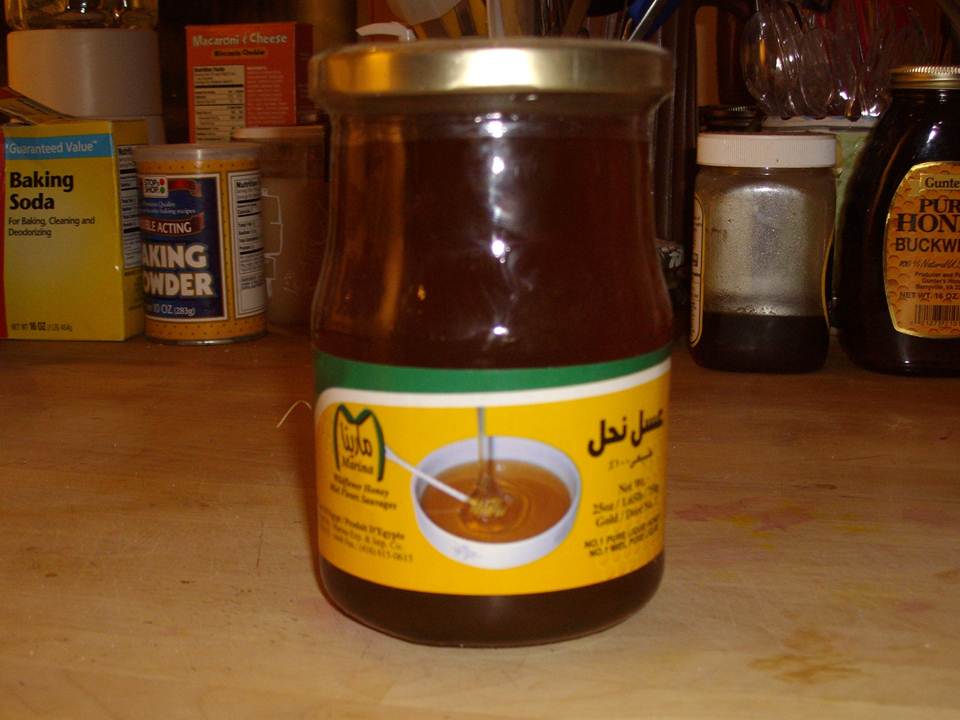
Egyptian Wildflower Honey Imported by Marina Import and Export Company
I can't remember where I got this wildflower Egyptian honey. I have a habit of ducking into small, local food shops and buying honey wherever I am, and my experience has been that some odd honeys show up in the oddest places (I've mentioned in the past that TJMaxx is, surprisingly, a good place to find unusual honey). I've never been to Egypt, so I know I didn't get it there. The grocer's price label on the jar says Supermarché Akhavan. The French 'supermarché' suggests I got it in Montreal, where I do go to Middle Eastern supermarkets (they have the best halva, chapati, and fresh feta cheese- as well as Middle Eastern honey).
This honey, apart from saying that it is from Egypt, that it is a wildflower honey, and that it is imported by Marina Import and Export company, doesn't say much else. I checked out whether Marina Import and Export has a website to see if I could find out more, and they do:
http://marinaexportimport.net/default.aspx
Their site states that they "specialize in importing ethnic and non-ethnic food products from Egypt, Syria, Saudi Arabia and Turkey." I notice they have a few things from Tunisia as well. Mostly they have food: sweets, beverages, nuts, and canned/jarred goods, but they also have water pipes and accessories as well as backgammon boards (the beautiful inlaid ones). They operate out of Scarborough, Ontario- which reinforces my thoughts that this honey was purchased in Canada. Unfortunately, they do not have any details about this honey. In fact, I can't find it on their list of products either, but the label is very much like the one on their molasses so I'm sure I have the right place.
So, I have no details about where in Egypt and what type of wildflowers. With no obvious source of information, I rely on Wiki. What I find is that most rain falls on a tiny strip of the northern coast of Egypt. Is it a fair guess that the flower source is there? According to Wiki, apart from this region, rainfall is scarce and limited to winter, with averages of less than 5mm per year. Add to this fairly intense heat with averages between 80-90°F (with some places getting over 100 °F) except along the coast. I wonder how flowers manage to flower, and if they do, how bees manage to find them without suffering heat exhaustion in any area except this coastal strip. How wrong I am! Another site (http://people.csail.mit.edu/hanna/Egypt/index06.html) states that most of Egyptian wildflowers flourish in the desert: "In the palm groves of the desert oases as in some of the narrow ravines in the eastern desert, ferns and flowers grow in a luxuriant abundance unknown to northern climes. Of these wild flowers the most common are the yellow daisy, the poppy, the iris, the asphodel and the ranunculus." Wouldn't it be great if this was desert wildflower honey? We will never know.
Now back to the honey. It is a nice golden, reddish color that is slightly opaque. It is surprisingly thick. I was expecting runny honey, given the color. Trying to twirl it on a toothpick, it has a feel of taffy. It twirls in a huge glob, and rolls around before it dissolves, like a hard candy. It has a very distinct first taste of tea, very faintly bitter or smoky tea. Very exotic. Tasting it again I think maybe it is faintly like an oak or bark flavor, slightly similar to an aromatic herb- but not so bitter as thyme honey. It is not too sweet and the after flavor is that of clear sweetness with undertones of the tea taste. I think for some this taste may take some getting used to. It is great right out of the jar, and would do well in dark teas, on whole grain breads and in hot cereal. I don't think it would be the best choice for baking or in herbal teas; it has too much of a distinct flavor.
Sunday, October 16, 2011
Miel de Printemps (Spring Honey), Plessis St Jean, France
Plessis St Jean is a community in the Yonne district of Burgundy, about 2 hours south of Paris. The district is named for the river that runs through it, and its capitol is Auxerre. Plessis St Jean is a small, picturesque village in the rolling, countryside of Yonne with about 200 residents. Moriot Joël owns a farm there and also collects and jars his own honey. It is a jar of his Spring Honey that I have.
It is hard to know what flowers are the source of this honey. I tried to research what types of spring flowers there are in the region but came up empty. I suspect that it is a mixture of many different meadow and forest wildflowers. I think honey that is not identified as having a specific source is likely collected from hives that are placed in fields with all sorts of things growing.
The spring honey that I have is cloudy, like a whipped honey. It is somewhat thick but doesn't loop onto a toothpick very well. It breaks off in threads. It has a shiny, glassy, almost oily sheen to it. It is very sweet. In fact, the sweetness overpowers any subtle perfumes it may have, and it stays sweet from beginning to end. Near the very end, though, there is a tiny (tiny) taste of flowers. I may be imagining it; I desperately want this honey to have a hint of spring flowers (!)
Given its even flavor throughout and its powerful sweetness this honey is perfect for baking or in fragrant teas where you don't want the honey to color or overpower the tea flavor. It may be less interesting on its own, on bread or in hot cereal.
M. Joël does not have a website so I suspect you can only find this honey locally.
It is hard to know what flowers are the source of this honey. I tried to research what types of spring flowers there are in the region but came up empty. I suspect that it is a mixture of many different meadow and forest wildflowers. I think honey that is not identified as having a specific source is likely collected from hives that are placed in fields with all sorts of things growing.
The spring honey that I have is cloudy, like a whipped honey. It is somewhat thick but doesn't loop onto a toothpick very well. It breaks off in threads. It has a shiny, glassy, almost oily sheen to it. It is very sweet. In fact, the sweetness overpowers any subtle perfumes it may have, and it stays sweet from beginning to end. Near the very end, though, there is a tiny (tiny) taste of flowers. I may be imagining it; I desperately want this honey to have a hint of spring flowers (!)
Given its even flavor throughout and its powerful sweetness this honey is perfect for baking or in fragrant teas where you don't want the honey to color or overpower the tea flavor. It may be less interesting on its own, on bread or in hot cereal.
M. Joël does not have a website so I suspect you can only find this honey locally.
Sunday, September 18, 2011
Miel des Savoies Tilleul (Linden Tree), France
This honey comes to me courtesy of my aunt Stephane (thank you Stephane!). It is Tilleul (Linden tree) honey from the Savoie, Rhône-Alpes region of France, a region I might add, that takes their honey seriously. Don't believe me? Check out the Honey Competition put on by the Syndicat d'Apiculture de la Savoie fondé à Albertville en 1893. The honey goes through rigorous analysis, including chemical analyses. In the most recently posted competition results (2010), 48 judges rated 43 valley honeys and 129 mountain honeys (it is a mountainous region after all) and came to the conclusion that given the exceptional summer they had had, ALL the honeys were of an irreproachable quality and had exceptional taste ("tous les miels présentés étaient d’une qualité irréprochable et d’un goût exceptionnel"). This is the type of competition I like to see: all winners. Well, sort of. In the end they did make further distinctions and gave out gold, silver and bronze medals to those apiarists who were the top of the top. I guess the take home message, though, is that you can't go wrong with a honey from Savoie.
If you'd like more information about the competition and the gold, silver and bronze medalists, here is the link:
http://www.rucher-des-allobroges.com/Concours_des_miels.b.htm#Concours_des_miels.b
But back to the Linden tree honey that I have (which doesn't list the apiarist, so I don't think it was a medalist). Linden trees, as you may know, produce fragrant and nectar-producing flowers, and the honey produced from these flowers has a creamy, pale yellow color (like whipped honey) and a grainy, sweet floral, woody smell. In fact the honey smells a little like Linden flowers. As an aside, Linden flowers are also used for herbal teas. It is a relatively thick honey so you can get a nice twirl of it with a toothpick. The twirl takes a little time to melt in your mouth, but as it is melting it has a mellow, subtle sweetness, followed by a burst of sweetness with a floral undertone. Overall, it isn't a very complicated honey, no unusual, unexpected flavors or radical change in taste as it melts. I think it would be great in baking and in teas, maybe less interesting on hot, buttered toast. In fact, I came across a Linden Honey Apple Pie recipe (that I can't seem to find now) that looks quite nice.
If you'd like more information about the competition and the gold, silver and bronze medalists, here is the link:
http://www.rucher-des-allobroges.com/Concours_des_miels.b.htm#Concours_des_miels.b
But back to the Linden tree honey that I have (which doesn't list the apiarist, so I don't think it was a medalist). Linden trees, as you may know, produce fragrant and nectar-producing flowers, and the honey produced from these flowers has a creamy, pale yellow color (like whipped honey) and a grainy, sweet floral, woody smell. In fact the honey smells a little like Linden flowers. As an aside, Linden flowers are also used for herbal teas. It is a relatively thick honey so you can get a nice twirl of it with a toothpick. The twirl takes a little time to melt in your mouth, but as it is melting it has a mellow, subtle sweetness, followed by a burst of sweetness with a floral undertone. Overall, it isn't a very complicated honey, no unusual, unexpected flavors or radical change in taste as it melts. I think it would be great in baking and in teas, maybe less interesting on hot, buttered toast. In fact, I came across a Linden Honey Apple Pie recipe (that I can't seem to find now) that looks quite nice.
Labels:
France,
honey,
Linden honey,
miel,
Rhones-Alpes,
Savoie,
Tilleul
Sunday, September 11, 2011
Miel de Sapin (Pine tree honey), Scherwiller, France
We spent a brief visit in Alsace, France this summer, and although not long enough to really explore the region, I had enough time to look for local honey in a small, convenience store in the village of Scherwiller (just north of Colmar and west of Selestat). That is where I found this 'miel de sapin' (pine tree honey). Miel de sapin is one of the specialties of the region. It is used, in fact, to make a traditional gingerbread cake that is eaten at Christmas.
But before I get into the honey, let me tell you how beautiful the region is. We drove down the 'route des vins' (wine road) from Mount St. Odile (a mountain top monastery with incredible views of the surrounding landscape) to Scherwiller (a small town in the verdant wine growing valley). We passed through many small villages along the way, each with the status of 'villages fleuri' (flowered village) and it was easy to see why. Each had timber exposed buildings lining the road with flower boxes full of colorful flowers, mostly geraniums in pinks and reds.
Scherwiller, as mentioned, is in wine country and the small village has a number of 'caves' to visit. It is especially known for its Reisling wine. From Scherwiller you can see the ruins of two medieval castles on the hills above it (Ramstein and the Ortenbourg). They can only be accessed on foot and although I would have loved to hike up to them, we didn't have enough time (my excuse to return to the area!). From what I could see, the vineyards occupied the gentle rolling hills adjacent to the Voges mountains (with some vineyards in town) and the flatter valley plains. The mountains themselves were covered in forests and in these forests were, among other trees, pine trees.
The miel de sapin that I have was produced in the Scherwiller area by Mr. Jean-Luc Schueller. It is a very dark brown honey that is rather thick. It has a subtle malted flavor, is only slightly sweet, and has a brief smoky/herby after taste. Very unusual. I can see how it might be very tasty in gingerbread. I think it would also be quite good in yogurt, tea or just on buttered toast. Eating it right out of the jar works too. Next time I'm back in Alsace, apart from hiking to Ramstein and the Ortenbourg, I know I'll be picking up another jar of this honey (maybe a very large jar).
But before I get into the honey, let me tell you how beautiful the region is. We drove down the 'route des vins' (wine road) from Mount St. Odile (a mountain top monastery with incredible views of the surrounding landscape) to Scherwiller (a small town in the verdant wine growing valley). We passed through many small villages along the way, each with the status of 'villages fleuri' (flowered village) and it was easy to see why. Each had timber exposed buildings lining the road with flower boxes full of colorful flowers, mostly geraniums in pinks and reds.
Scherwiller, as mentioned, is in wine country and the small village has a number of 'caves' to visit. It is especially known for its Reisling wine. From Scherwiller you can see the ruins of two medieval castles on the hills above it (Ramstein and the Ortenbourg). They can only be accessed on foot and although I would have loved to hike up to them, we didn't have enough time (my excuse to return to the area!). From what I could see, the vineyards occupied the gentle rolling hills adjacent to the Voges mountains (with some vineyards in town) and the flatter valley plains. The mountains themselves were covered in forests and in these forests were, among other trees, pine trees.
The miel de sapin that I have was produced in the Scherwiller area by Mr. Jean-Luc Schueller. It is a very dark brown honey that is rather thick. It has a subtle malted flavor, is only slightly sweet, and has a brief smoky/herby after taste. Very unusual. I can see how it might be very tasty in gingerbread. I think it would also be quite good in yogurt, tea or just on buttered toast. Eating it right out of the jar works too. Next time I'm back in Alsace, apart from hiking to Ramstein and the Ortenbourg, I know I'll be picking up another jar of this honey (maybe a very large jar).
Subscribe to:
Posts (Atom)