Search This Blog

Showing posts with label miel. Show all posts

Monday, January 18, 2016

Miel de la Beebliothèque (Library Honey), Westmount, Québec, Canada

Last December we visited my mother in-law who lives in Westmount, Quebec, a western suburb of Montreal, and she gave me a small jar of honey that was produced by her local library, the Westmount library. It turns out that in 2015 the library installed a few hives on their roof and sell honey to raise money. "What on earth are librarians doing keeping bees?" you might ask. Good question. But, in fact, the librarians haven't turned apiarist but rather have enlisted the services of an urban beekeeping service, Alvéole, to install and maintain their hives, and extract honey at the end of the season. 

Westmount Library
 An urban beekeeping service?  Yes. Started in 2012, Alvéole is the brain child of three beekeeping friends, Etienne Lapierre, Alexandre McLean and Declan Rankin. To combat the recent declines in bee populations due to environmental changes, the use of pesticides and new bee parasites and illnesses, the three thought bringing bees to an urban center, like Montreal, might be (part of) the solution. You see, in Montreal there are strict anti-pesticide regulations and an abundance of untapped floral sources. Local hives would produce quality local honey, increase local pollination rates and contribute to making the city greener, as well as protect and harbor bee colonies. Win, win, win.

The idea caught on and there were many takers. By 2015 Alvéole had >70 corporate and private clients across Montreal island and the south shore, and they continue to grow (and have recently expanded into Toronto). What do the Westmount library, Birk's Jewelers, Aldo shoes and the Public Works Office of St. Lambert all have in common? They all have hives on their roofs courtesy of Alvéole.

Westmount park
For about $750 CAN the first year, Alvéole will set everything up, take care of the hives, and extract the honey at the end of the summer. They guarantee 10 kg of honey to the client and keep the rest, which they sell in their store and on-line. The honey is 100% pure, filtered and unpasteurized. Given that each hive produces about 15-20 kg of honey per year, there is plenty of honey to go around.  Under the Alvéole label, they sell honey by Montreal island region: Villeray, Sud-Ouest, Plateau, NDG Westmount. The different floral sources of each region give each a unique taste and texture. And apart from honey, Alvéole also sells lip balm, soap, totes and a yearly calendar featuring nude apiarists! Check out their on-line boutique.

Westmount library was founded in 1897 in commemoration of Queen Victoria's Diamond Jubilee, and two years later, the grand Victorian building that has housed it for all these years was built in 1899. The library is adjacent to Westmount park, a verdant oasis of trees, flowers and water features. I can't think of a better place for hives. 

Miel de la Beebliothèque (Library honey)
The name of the miel de la Beebliothèque is a play on words of the French word for library, 'bibliothèque.' 

The honey is very light yellow and clear, but quite thick. It is not too sweet and has a floral first taste with a strong menthol herbal after taste. It makes me wonder if their are any eucalyptus trees in the park. Next time I visit I'll have a look around. It is very tasty, and would be great drizzled on plain yogurt or on hot, buttered toast, and in a strong cup of black tea. If you are in Montreal, head to the Westmount library on Sherbrooke street to check out their honey (while supplies last), or go to the Alvéole store at 5425-217 Rue de Bordeaux for Montreal island honey and ask for the NDG Westmount region, or save yourself the trip(s) and check out the online boutique.


Tuesday, June 23, 2015

Maquis, Miel du Pays D'Oc, Monséret, France

View from the ruins of Peyrepertuse to the ruins of Queribus
We were recently in Aude, in the Languedoc-Roussillon region in the south of France. It is near the Mediterranean coast and the border of Spain. It is an absolutely beautiful area of France and I highly recommend a visit. Between visiting world renown, local vineyards, sampling wines and local cuisine (cassoulet, a rich, slow-cooked casserole containing meat (usually pork, sausages, goose or duck), pork skin and white beans, is a specialty, especially in the Carcassonne area), visiting abbeys and castles (this is the area of the "Cathar" castles; pictured is Peyrepertuse, one of my favorites), and hiking through some breathtaking scenery, there is a lot to see and do. 

Monséret, France (in red, lower right area)
On one side trip we visited a miellerie in Monséret, La Miellerie de Clauses.  Monséret is a small wine-producing village in the wine district of Corbiers and the miellerie is found on the outskirts of the village in an area of wild scrubland. During the summer season the miellerie offers educational tours of their facility and pony ride tours through fields where their honey is collected.  They do everything from tending hives, to extracting honey, to distributing it. We, unfortunately, were there before the season began so we didn't get an up close view of their production and had to be content with sampling the varieties of honey a their store's honey tasting bar (rosemary, forest, thyme, acacia and others) and perusing other honey products that they make and sell (honey cake, and mead among others).  One of the honeys that they produce is maquis honey, a honey I've never had before. I also didn't know exactly what "maquis" was.
La Miellerie de Clauses

Maquis isn't a flower source but a biome (geographically contiguous area with similar climatic conditions, also referred to as an "ecosystem") in the Mediterranean region. It generally is made up of densely growing shrubs including holm oak, sage, juniper, buckthorn, spurge olive and myrtle (among others) and is found throughout the Mediterranean Basin. The name comes from the plural of the Italian "macchia" which means "thicket." Maquis, given its height and density, provides ideal cover for bandits and guerrillas, and its name has been used to refer to a few guerrilla movements, notably the Maquis in World War II, a band of the French Resistance, and the Spanish Maquis, a guerrilla group that fought against the Franco regime in the aftermath of the Spanish Civil War. Interestingly, it has also been used as the name of the fictitious anti-Cardassian resistance movement in an episode of Star Trek: Deep Space Nine.  Members of the Maquis were known as "maquisards" and the Italian for "becoming a fugitive" is "darsi alla macchia."

Maquis near Monséret, France
Maquis is similar to the English heath, but with taller (and different) shrubs and it tends to be found in arid, rocky areas supportive of drought-resistant plants. Maquis is also similar to "garrigue." Both are translated as "scrubland" in French. However, maquis is more dense than garrigue and grows in more acidic soil, whereas garrigue is associated with low bushes growing widely spaced from each other on base rich soils (i.e. limestone). Both maquis and garrigue are found in the Mediterranean basin and the two terms are often used interchangeably.


Maquis honey, Meillerie de Clauses, Monséret, France
My maquis honey is an opaque, mellow, orange-brown color. It is nearly all crystals a, so possible a quick crystallizer. It has a heady, summer flower aroma, faintly floral but with herbal and vaguely menthol overtones. I can almost feel the heat of a Mediterranean sun beating down and hear the sound of cicadas and bees. It isn't overly sweet and the medium sized crystals dissolve quickly, so it doesn't have an overly grainy texture. It has a robust herbal, grassy, earthy taste that is slightly bitter, reminiscent of thyme or forest honey, with a very subtle, fleeting, floral and menthol after taste. Very tasty. It may be too strong for a delicate herbal tea, unless you want to add additional flavor, but probably a good choice for a dense honey cake or mixed into thick, plain yoghurt. Right out of the jar it is pretty good too!


Tuesday, April 1, 2014

Labonté Pure & Natural Organic Honey (Brazil) Victoriaville, Quebec, Canada

Labonté honey has been a fixture in Quebec for over 70 years. In 1937 Rolland Labonté started the business in Victoriaville and it has grown into a large, global operation. Jean-Marc Labonté continues the tradition as the current head of the company. Labonté honey offers local Quebecois honey (blueberry, clover, and "pure and natural" which is probably a wild flower mix), and packages and distributes honey from Brazil (eucalyptus and organic pure and natural). You may know them for their "upside down pack no mess" honey bottles. They also produce maple syrup and offer bulk honey. And they aren't kidding when they call it bulk; their bulk containers range in size from 7 kg to 30 kg pails to a 1,400 kg Intermediate Bulk Container (IBC). It is hard for me to imagine the scale of 1,400 kg of honey. I envision a small swimming pool of liquid gold, which isn't too far off (see photo of 1,000 liter IBC containers).
 
1000 liter IBC containers
 Labonté honey also prides itself in its quality assurance program and are HACCP certified (i.e. use the Hazard Analysis Critical Control Point Food Safety Management System), are ECO certified and BIO certified (for their organic products). If you want guarantees that you are getting 100% natural honey, you can't go wrong with Labonté honey.
 
The honey I have is their "pure & natural organic honey" from Brazil. I checked the Labonté honey website to see if there was any more information about the honey-where in Brazil, what the floral was, etc.-but came up empty handed.  Usually if a floral source isn't specified it is a wild flower blend. 
Labonté Pure & Natural organic honey from Brazil

The honey is an amber golden color, very clear and of medium thickness, exactly what you think of when you think of honey. I don't see any particulate matter in it. It has a uniform sweet flavor with a hint of eucalyptus menthol at the end. This makes me think that they may place hives in the border areas around a eucalyptus forest or some batches of their eucalyptus honey have too much pollen from other sources, so it ends up being "pure and natural organic honey" rather than eucalyptus honey.  In my opinion some of the most interesting honey has multiple floral sources. 
 
This is a very good quality, robust honey that will please anyone who likes traditional honey. It is perfect for hot toast, baking or adding to tea or hot cereal.


Tuesday, January 7, 2014

Maya Miel, Oxkutzcab, Yucatan, Mexico

Oxkutzcab (red), Yucatan peninsula in Mexico
My friend Barbara recently vacationed in Mexico and  brought me back honey from Oxkutzcab, a town in the Yucatan state of Mexico. Interestingly, according to Wiki the name 'Oxkutzcab' in the Yucatec Maya language means 'place of ramon, tobacco and honey.' This sounds very promising. But first, what is ramon? It turns out it is a tree (Brosimum alicastrum) known as the breadnut or Maya nut tree and is part of the family of trees that includes mulberries and figs. In some indigenous Mesoamerican languages it is known as 'ox,' and I'm assuming the 'Ox' in 'Oxkutzcab' refers to it. But, back to Oxkutzcab.

Oxkutzcab is a small town, with a population of about 21,000. It is an agricultural community where sugar, tobacco, maize, fruit, and Henequen is grown. Henequen (Agave fourcroydes) is an agave. The leaves are very fibrous and are used to make rope and twine.

Iglesia a san Francisco de Asis, Oxkutzcab, Yucatan, Mexico
Oxkutzcab is also a very old town, dating back to pre-Columbian times. If you google Oxkutzcab and look for images you'll see many of a very beautiful and impressive church, the iglesia dedicada a san Francisco de Asis. According to web sources, after the Spanish conquest of Yucatan, Oxkutzcab was established as a Spanish colonial town (1550s) and Mayan temples were demolished. In their place this large Franciscan church was built. The current iteration was built between 1640-1693, and in front of it is the town's large market square.

Oxkutzcab, which has a number of interesting tourist attractions, is known for its "Festival of Oranges" (Feria de la Naranja). This isn't too surprising since the municipality of Oxkutzcab is known as the 'Orchard of the State of Yucatan.' I won't be surprised if the honey from the area has a citrus quality.


29th Annual Festival of Oranges, Oxkutzcab
The Festival of Oranges happens at the end of November each year, and as far as I can gather they celebrate everything citrus (and a few other local specialties) from local producers. I found a fantastic photos of the 29th annual festival showing a very impressive tree made of oranges and other citrus. In addition to being able to buy and sample produce, judges award prizes, there there are musicians and artists, and fireworks.

The town is also known for its tricicleros, a kind of a bicycle with two wheels in the front separated by a support, where you can transport passengers or haul loads.

Tricicleros, Oxkutzcab, Mexico
 I also found some information about beekeeping in the Yucatan. It seems that honey has been harvested in the area for as long as there have been people there. Currently there are an estimated 11,000 beekeepers in the state. More recently, to be more attractive to European buyers, some beekeepers have formed collectives that share equipment and marketing costs, and produce and harvest organic-certified honey. The rural, unspoilt area and traditional beekeeping methods make the Yucatan particularly well suited to producing organic honey. In 2011-12 it was estimated that  8-10,000 tons of honey were produced, with most of it being sold in Germany.

Maya Miel, Oxkutzcab, Yucatan, Mexico
The honey I have is packaged and produced by Maya Miel of Tekax, a small town just south of Oxkutzcab. Their website is pretty basic but states that their honey is 100% natural Yucatan honey and of the highest quality. The honey is an opaque reddish-yellow color. The opacity suggests that it has not been overly filtered so that some of the particulate matter and pollen have been retained. The honey is very thin and difficult to twirl enough on a toothpick to sample. It has an herbal first flavor with light, subtle slightly bitter (citrus?) after taste. It is not too sweet. Given how thin and runny it is I think it would be perfect drizzled on yoghurt or hot buttered toast. The flavor is delicate, however, and may be lost in baking or other cooking, though it might add a nice taste to herbal and black teas.


Sunday, November 10, 2013

Miel d'Acacia (Acacia (Black Locust) honey) Brive-la-Gaillarde, France

According to Wiki, prior to 2005 Acacia was a genus of shubs and trees that contains about 1,300 species. Most (>950) are native to Australia and the rest spread around warm-temperate regions including Europe, Africa, southern Asia and North and South America. In 2005 the genus was divided into five separate genera. The genus Acacia was retained for most Australian species and a few in tropical Asia, Madagascar and the Pacific Islands. Most species outside of Australia (and a few Australian species) were reclassified as genera Vachiella and Senegalia, and a few dozen species from the Americas were classified under the genera Acaciella and Mariosousa. To get a better appreciation of the diversity and geographic location of this genus of shrubs/trees I direct you to the French Acacia wiki-site. Of note, the names 'acacia' comes from the Greek for thorn, 'akis.' Also of interest, most Australian acacias are not thorny, while most non-Australian ones are. This makes me wonder how acacia got its name when most of the genera are Australian and not thorny. The answer is that Carl Linnaeus, a Swedish botanist, is credited with first describing the acacias and his description is based on a thorny African species. Imagine if he had been working in Australia, the acacias would be called something completely different.

Acacia blooms
 Changing the taxonomy was apparently a very controversial move.Those who don't agree with the changes continue to use the old taxonomy. All this to say that it is a little bit confusing to know what Genus species to attribute to the source of the acacia honey I have that originates in France.

To complicate matters, there is a tree commonly called 'False Acacia' (Robinia pseudoacacia) or 'Black Locust' that is widely found in Europe and North America, as well as in other regions (it is native to North America but has been successfully cultivated in other countries). This is the tree that I had always known as 'acacia.' In fact some online research state that Robinia pseudoacacia is the source of acacia honey in France. Could it be that Acacia honey is in fact not Acacia honey, but Black Locust honey? I think this is the case (!)
Black Locust (False Acacia) blooms

It seems that Black Locust is a major honey plant. It has a very short (about a week) blooming period (usually at the end of May and beginning of June). Blooms, which are extremely fragrant, are very sensitive to weather conditions, though, and this results in inconsistent honey productions year to year.

Apart from an excellent source for honey production, Black Locust wood is hard, resistant to rot and durable, making it suitable for furniture, flooring, etc. It is also planted for fire wood as it grows quickly in a variety of soils. The bark and leaves of the Black Locust are toxic but the seeds, young pods and flowers are edible; whatever poisons they contain are sensitive to heat. I can personally attest to this. My aunt makes acacia doughnuts by coating the flowers in pancake batter, quickly deep-frying them in oil and serving them with powdered sugar. The flowers have a very sweet, floral fragrance and the doughnuts taste as good as they smell. Acacia doughnuts are a real treat and a sign that summer has almost arrived.

Acacia doughnuts (beignets d'acacia)
My acacia honey comes from Brive-la-Gaillarde in France and was produced and distributed by Armondo and Dominque Filipe who are apiarists near Ussac, just north of  Brive-le-Gaillarde. Brive-la-Gaillarde is located in the south west of France in the Limousin region in the Corrèze department. The Filipes have produce honey and other products under the "Miel du pays de Brive" et "Limousin Gourmand" brands for over 15 years, and also make and sell hives.They have a wonderful website describing their operation and products (including acacia, bourdaine (black alder), tilleul (linden), montagne (mountain) and Châtaigner (chestnut) honeys, royal jelly and pollen). They also welcoming visitors, in case you are ever in this lovely region of France.

Brive-la-Gaillarde, France (in red)
 Their story is interesting. In 1995, out of curiosity, they bought 2 hives. Fast forward 15 years and they now have >400 and a thriving honey business. Also of note, the Filipe's label for their honey depicts St. Martin's church in Brive-la-Gaillarde (see honey photo below).

If the truth be told, I've had this honey for a while. I got in on a trip to Limousin years ago (the label says that it is best to consume it by 2004!) Acacia honey is usually a very clear, very light yellow color, but my honey has mellowed and is now a robust reddish-orange, although still very clear. It has a medium consistency and a very clean, uncomplicated, delicately floral, moderately sweet taste from beginning to end. Given how long I've had this honey I can confirm that acacia honey is not a fast crystallizer. In fact, even after all these years, this honey is clear and crystal free. 

Acacia (Black Locust) honey From Brive-la-Gaillarde, France
Acacia honey is ideal drizzled on plain yoghurt, in teas (the flavor is delicate and won't change the taste too much), in hot cereal or in baking. It is also very tasty on its own. The fact that is is a very slow crystallizer also makes it a good choice to spread on toast or for people who don't use honey much but when they do don't want to warm it up to get rid of crystals.


Monday, October 1, 2012

Miel de Bruyère Callune (Heather Honey), Anjou, France

"Bruyère Callune" is Calluna vulgaris, or common heather. It is a low growing perennial shrub and is found widely throughout Europe. It thrives in acidic soils and is the dominant plant in heaths and moors. It generally has purplish flowers and blooms in late summer, and is sometimes referred to as Summer heather. White flowers do sometimes occur and these are thought to bring luck. Calluna vulgaris should not be confused with Erica vulgaris, another common heather. Erica vulgaris blooms in Winter/Spring (and is therefore completely different). Think about Scotland (where heather grows abundantly) and imagine 'fragrant hills of purple' and you may picture it. 

According to wiki there are a lot of uses for heather- apart from as a source of food for sheep and deer. It is used to dye wool yellow and to tan leather. It is an ingrediant to add flavoring (before hops) in the brewing of heather beer ( a Middle Ages brew). Of interest, the use of heather as a flavoring for beer is carefully regulated today because the undersides of its leaves may contain a fungus that has hallucinogenic properties. Heather beer must have been a popular beverage in the Middle Ages!


The honey I have is French and comes from the Anjou region, now the department Maine-et-Loire. The label claims that it is heather honey that is collected on the edge of a forest in the heart of Anjou.
Anjou is a beautiful, historic area of France. It has been a county (ruled by a count, circa 880 AD), duchy (ruled by a duke, circa 1360 AD), province, and now is a department. It is centered around the city of Angers and is located in the lower Loire valley of western France.

 Anjou is changed hands many times. The Gauls, Romans, and Franks have all had turns. And Brittany and Normandy seem to have constantly threatened its autonomy. Being under constant threat from its neighbors the area is full of fortified castles and ancient battlefields. Charles the Bald, Robert the Strong, Hugh the Abbot, Odo, Fulk the Red, and Geoffrey Greytunic, all figure prominently in its early history.

It is home to the tombs of Plantagenets Eleanor of Aquitaine and Henry II at the abbey of Fontevraud, and it has many châteaux: Angers, Saumur, Brissac, Serrant, Le Plessis-Macé, Montsoreau, Le Plessis-Bourré, and Montreuil-Bellay. The National School of Horsemanship (École Nationale d'Équitation), and the tank museum (Musée des Blindés) are also in the region. It is also a major wine growing region. If you are into beautiful countryside, romantic and fortified castles, wine, history, horses or armored vehicles, Anjou may be a good destination choice.

Anjou may also ring a bell because of the Anjou pear. According to wiki, it was all a big mistake. For some reason when the pear was introduced to the US, it was called Anjou but it actually seems to have originated in Belgium. Its original name was Nec Plus Mauris. How did they get from this to Anjou? It is a great mystery.


The miel de buryère callune is a warm, clear, amber color. It is medium thick and very smooth. It has been described as having a gelatinous texture and I can see why. It is not too sweet with a subtle clear herbal flavor that then ends with a slightly bitter woodsy up tone. It would be good in baking (ginger bread), in hot cereal, on toast, but may change the flavor of tea.


Sunday, September 16, 2012

Rosemary Honey (Miel de Romarin), Col de Pointu, Bonnieux, France

Rosemary honey is from rosemary, or Rosmarinus officinalis, a woody, perennial herb with fragrant needle-like leaves and white, pink, purple or blue flowers. According to Wiki, it is native to the Mediterranean region, and the name 'rosemary' comes from Latin. It translates as "dew" (ros) and "sea" (marinus), or "dew of the sea", because it is very drought resistant, needing only the humidity carried by the sea breeze as a water source to sustain itself.

Rosemary

Rosemary is used both dried and fresh is cooking, and it is reported to have some medicinal qualities especially related to treating gout, and improving memory. Of note, a miraculous balm containing rosemary (balm of Fierabras) is described in Don Quixote, and given its association with memory, rosemary is used as a symbol of remembrance; it is often depicted on war commemorations, worn on Remembrance Day in Australia, and, in funerals, it is thrown into graves to remember the dead. Also according to Wiki, in the Middle Ages, rosemary was used in wedding ceremonies as symbols of love and loyalty. The bride would wear a rosemary headpiece and the groom and guests would wear sprigs of rosemary, and newlyweds would plant rosemary on their wedding day. If the plant grew it predicted a strong marriage and family.

Rosemary was also believed to repeal witches if planted in the garden, and this association between witches and rosemary then morphed into being a symbol that women ruled the household in homes where rosemary grew. There are accounts of men in the 16th century ripping up rosemary to show that they and not their wives ruled their households.


Bonnieux, France


Bonnieux, France, where this honey was produced is a beautiful, fortified village that dates from 972 AD,  nestled at the top of the Luberon hills, in the Vaucluse department in the Provence-Alpes-Cote-d'Azur region in the southeast of France. It is east of Avignon and north of Aix en Provence. It sits opposite of Mont Ventoux and has a commanding view of the valley.

If you make your way up through the village, there is a stone staircase, and at the top is the 12th century village church (and a small park, apparently, that is ideal for a picnic). The views, if the tourism information is to be believed, are glorious.

Stone Stairs leading to the 12th Century Church

Bonnieux also also known for its bread museum, the Musée de la Boulangerie. It describes all there is to know about making artisan bread. Considering how well bread and honey go together, if you are in the area, it may be well worth a visit, after which you can take some Bonnieux honey and artisan bread, and picnic in the park next to the hill top church, while appreciating how wonderful it is to be alive in this small slice of heaven.


La Mas des Abeilles produced the rosemary honey that I have. It is located on the summet of the Luberon, near Bonnieux, and it is a family business. They select, package and export honey and honey products from the area, and have been doing so for over 30 years. They take great pride in their honey. It is produced in the artisanal fashion: harvested using the blowing method ('soufflage' in French), and cold extracted to retain the best honey flavor. No preservatives or anything artificial.

The rosemary honey I have has started to crystallize but it still has a top layer of liquid honey. it is a mellow golden, light amber color. It is a thin, runny honey but with some body. It is smooth, with an herby, slightly bitter flavor from beginning to end, and then there is a small burst of sweetness. If you've ever crushed a sprig of rosemary, it tastes like a sweet and subtle version of the smell. I associate rosemary with summer and this honey embodies hot summers for me.

Rosemary (Romarin) Honey

It isn't a complicated honey in that the flavor or tones change from beginning to end, but it is very high quality honey with a distinct flavor. I think it would be a good choice in cooking, especially if rosemary is in the recipe, and it would be nice in herbal tea or on toast.

Le Mas des Abeilles has a lovely website, if you are interested in this rosemary honey or other products they sell.


Thursday, August 2, 2012

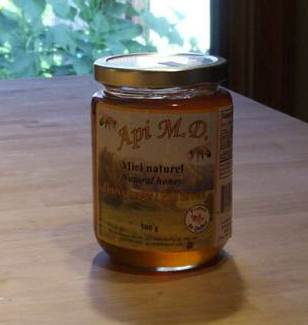
Wildflower honey (fleurs sauvages), Api M.D., Mansonville, Québec, Canada

No visit is complete when we visit my in-laws' cottage on lake Memphramagog in the Eastern Townships of Québec without a walk to Jewett's store. The cottage is in Vale Perkins, which, as far as I can tell, means it is within walking distance of Jewett's. There isn't any semblance of a town or anything called Vale Perkins. There is no sign "entering" Vale Perkins. It is just a dot on a map that corresponds to the crossroads where you'll find Jewett's store. It is too bad the town isn't called Jewett's because then it would be less confusing.

Jewett's is a common name in the region. As you make your way from Mansonville (the closest real town with a post office and everything) to Vale Perkins you pass quite a few farms owned by different Jewett's. I know that when I start seeing wooden signs with the name Jewett's on them I'm not far from the lake or the cottage. 

Jewett's store is a sight to behold and well worth the walk, even on a sweltering, hot day. Although their stock may have changed over the years, the store probably hasn't since before the beginning of time. It is a throwback to dry goods stores in the wild west. The floors are made of weathered wide-planked oak and creak when you walk on them. Shelves line every wall, and every nook is full of something. It is a testimony to efficient use of space. They have it all: from fresh eggs, to local cheeses, cake mixes, snorkels and fireworks. If Jewett's doesn't have it, you probably don't need it.

This past visit, on the road to Vale Perkins, I noticed bee hives (see below). When I did my pilgrimage to Jewett's I asked about them and Ms. Jewett showed me a shelf behind the cash where they stock local honey, saying she had some of it for sale. I picked wild flower. [There were a few other varieties but I'll save them for future visits.]


The apiarist is "Api M.D." and apart from saying the honey is wildflower, a product of Québec and out of Mansonville, the label doesn't give any other information. I searched online to get more but came up empty.

On a hike in the area, I looked for wildflowers. Here is what I found. Don't ask me if I know the names of anything, I don't. On a few flowers I saw honey bees, so it looks like I was in the right place.


The honey itself is a very runny, clear, slightly orange honey. It is very thin and takes a bit of effort to get any to stay on a toothpick long enough to sample. It has a very smooth taste. It is very sweet and has a floral undertone, and then it melts and is gone. There are no complicated flavors, it is just pure throughout. If you need a very runny honey- to spread on something or drip into tea, this is a good choice. The flavor is subtle and may add to an herbal tea (like camomile) but won't overpower whatever you add it to. As far as I know you can only get it at Jewett's store; take note: it is on a shelf, behind the cash in the front.


On this visit to Jewett's I also got another honey from "Cousin Bob" in Ontario (a cousin of the Jewett's who has a bed and breakfast and apiary). In the same time frame I was asked by a fellow blogger, and honey-phile, Elizabeth Gowing if I might like to guest blog on her site. She is an intrepid writer, traveler, beekeeper, and adventurer, and I couldn't say yes to her fast enough (!) She showcases honey and honey recipes and I used Bob's honey (a very good quality table honey) in a comforting tea recipe from Najmieh Batmanglij’s wonderful cookbook “Silk Road Cooking, A Vegetarian Journey.” Check out Elizabeth's blog, 100 days of honey and see my guest blog spot. Be prepared for some exotic honey recipes!


Saturday, June 9, 2012

Miel de Sologne

This honey comes from the Sologne region in France. Sologne is in central France and is bounded by the river Loire to the north, the river Cher to the south, and Sancerre and Berry to the east. It is a beautiful part of France, thanks in some part to Napoleon III who supported filling in the swamps and planting trees in the area in the 1800s. It is now a region of forests and lakes, and is known for its beautiful countryside, its châteaux (Chambord, Cheverny and Chenonceau to name a few), hiking, biking, and fishing. I guess it goes without saying that it is a great place to vacation. On a random note were you ever forced to read the book "Le Grand Meaulnes" by Alain-Fournier? It was required summer reading for me in high school. Well, it is set in the region of Sologne and is where Meaulnes becomes lost and ends up at the mysterious estate.


The honey I have is simply 'miel de Sologne' and the label states that the flower sources are forest and meadow flowers of the region: heather, chestnut and bramble being the main sources.

Heather belongs to the Ericaceae family of plants, which is a large family that includes over 4000 species across 126 genera (according to wiki), making it one of the most speciose family of flowering plants. In fact, the family includes quite a diverse group of plants that I would not normally have put together: blueberries, rhododendrons, and heather, to name a few.


We have done some hiking in Sologne and can attest to the prevalence of bramble (wild blackberry and raspberry bushes) in the forests (along with small, sour strawberries that taste like sweettarts). We always carried a plastic ziplock bag to collect berries when we were out hiking. There is nothing like hot, ripe, sticky berries fresh off the bramble.


Chestnut trees are also quite common in the area. Apparently around the world there are eight or nine types of chestnut trees, which are a species of deciduous trees in the Fagaceae family, but only one type is found in Europe (Castanea sativa), so it is probably safe to say which kind of chestnut tree was the source for this honey. Chestnuts, however, should not be confused with horse chestnuts which have similar nuts but are, in fact, not at all related to chestnuts.


Of interest, chestnuts have a long history in Europe. It has been reported that Alexander the Great and the Romans planted chestnut trees across Europe while on their various campaigns, and the Greek army is said to have survived their retreat from Asia Minor in 401-399 BC thanks to their stores of chestnuts. Furthermore the ancient Greeks Dioscorides and Galen, wrote of how eating too many chestnuts induces flatulence (so be warned).


Miel de Sologne is clear and dark honey. It is a thin, though, and takes a few swirls to get enough on a toothpick to sample. It has a smooth texture with a strong taste of resins with a smoky after taste. This is mostly the chestnut source coming through, which is a very dominant flavor. It isn't a complex honey. There are no subtle flavors that come and go, but it is a robust honey with a sharp, woodsy, smoky flavor. It is probably not for everyone, and would change the taste of a delicate tea. I'd recommend it on hot buttered German bread, or on hot cereal. I'm not sure where you can get it, other than in Sologne, so you just may have to plan a trip to France.


Sunday, January 29, 2012

Star Thistle (Centaurée) Honey, Maria, Gaspésie, Québec, Canada

This honey is from the Gaspésie, a peninsula running along the south shore of the Lawrence river at the Eastern most tip of Quebéc, Canada. The shore bordering the river is made up of sea cliffs, and the interior of the peninsula is rugged, mountain country containing the Chic-Chocks mountains (a northern continuation of the Appalachian mountains). The interior region, which is mostly covered by coniferous forests, offers some of the most rugged terrain in Quebéc with great hiking, dog-sledding, snowmobiling, downhill skiing, cross-country skiing and snowshoeing. In fact, the January/February 2012 issue of National Geographic Traveler ranks the Gaspésie in the top 10 winter adventure destinations in North America. Most of the population, however, is spread along the coast in small villages of less than 5,000 and for generations have mostly relied on fishing, although agriculture, forestry and tourism also now figure in their economy. The largest city, Gaspé (population around 15,000) is found near the tip of the peninsula.


Maria, Gaspésie, where this honey is from, is on the south shore of the peninsula, along the coast of the Baie des Chaleurs. The area was originally inhabited by the Micmac indians, but around 1775 American Loyalists, and immigrants from Scotland and Ireland, settled there. In 1860 Acadians looking for farmland joined them. The area is mostly made up of farms (cattle and dairy) but also has a sizable honey production. The Rucher des Framboisiers (Raspberry beehives), owned by John Forest and family, has 900 hives and has been producing a variety of honeys in the area since 1977. You can visit "Le petit jardin de l'abeille" (the little bee garden) from June to September to get a tour of their not-so-little gardens, and also get information about honey production. They also have a souvenir shop where you can buy their honey [1059 Dimock Creek, Maria, Québec, Canada, G0C 1Y0].


The honey I have is Star Thistle. I had to google image it to see what kind of a plant it is. It looks like a rugged survivor. Apparently it is considered to be a noxious, invasive weed (part of the knapweed family). Nevertheless, beekeepers prize it for its ability to produce large amounts of quality honey.


Star Thistle honey is a light golden color with a medium body. It has a relatively simple clear taste, not too sweet, with a slightly spicy undertone that tastes a little like cinnamon or allspice. The spiciness is not overpowering so I don't think it would alter the flavor of tea or baked goods much, and might add a little zest. It would also be very nice on hearty buttered toast, or in hot cereal. If you are ever in the Gaspésie, you might consider taking a side trip to Maria to check out The Rucher des Framboisiers' gardens and visitor center. I know I will!

Sunday, October 16, 2011

Miel de Printemps (Spring Honey), Plessis St Jean, France

Plessis St Jean is a community in the Yonne district of Burgundy, about 2 hours south of Paris. The district is named for the river that runs through it, and its capitol is Auxerre. Plessis St Jean is a small, picturesque village in the rolling, countryside of Yonne with about 200 residents. Moriot Joël owns a farm there and also collects and jars his own honey. It is a jar of his Spring Honey that I have.

It is hard to know what flowers are the source of this honey. I tried to research what types of spring flowers there are in the region but came up empty. I suspect that it is a mixture of many different meadow and forest wildflowers. I think honey that is not identified as having a specific source is likely collected from hives that are placed in fields with all sorts of things growing.

The spring honey that I have is cloudy, like a whipped honey. It is somewhat thick but doesn't loop onto a toothpick very well. It breaks off in threads. It has a shiny, glassy, almost oily sheen to it. It is very sweet. In fact, the sweetness overpowers any subtle perfumes it may have, and it stays sweet from beginning to end. Near the very end, though, there is a tiny (tiny) taste of flowers. I may be imagining it; I desperately want this honey to have a hint of spring flowers (!)

Given its even flavor throughout and its powerful sweetness this honey is perfect for baking or in fragrant teas where you don't want the honey to color or overpower the tea flavor. It may be less interesting on its own, on bread or in hot cereal.

M. Joël does not have a website so I suspect you can only find this honey locally.

Sunday, September 18, 2011

Miel des Savoies Tilleul (Linden Tree), France

This honey comes to me courtesy of my aunt Stephane (thank you Stephane!). It is Tilleul (Linden tree) honey from the Savoie, Rhône-Alpes region of France, a region I might add, that takes their honey seriously. Don't believe me? Check out the Honey Competition put on by the Syndicat d'Apiculture de la Savoie fondé à Albertville en 1893. The honey goes through rigorous analysis, including chemical analyses. In the most recently posted competition results (2010), 48 judges rated 43 valley honeys and 129 mountain honeys (it is a mountainous region after all) and came to the conclusion that given the exceptional summer they had had, ALL the honeys were of an irreproachable quality and had exceptional taste ("tous les miels présentés étaient d’une qualité irréprochable et d’un goût exceptionnel"). This is the type of competition I like to see: all winners. Well, sort of. In the end they did make further distinctions and gave out gold, silver and bronze medals to those apiarists who were the top of the top. I guess the take home message, though, is that you can't go wrong with a honey from Savoie.

If you'd like more information about the competition and the gold, silver and bronze medalists, here is the link:

http://www.rucher-des-allobroges.com/Concours_des_miels.b.htm#Concours_des_miels.b

But back to the Linden tree honey that I have (which doesn't list the apiarist, so I don't think it was a medalist). Linden trees, as you may know, produce fragrant and nectar-producing flowers, and the honey produced from these flowers has a creamy, pale yellow color (like whipped honey) and a grainy, sweet floral, woody smell. In fact the honey smells a little like Linden flowers. As an aside, Linden flowers are also used for herbal teas. It is a relatively thick honey so you can get a nice twirl of it with a toothpick. The twirl takes a little time to melt in your mouth, but as it is melting it has a mellow, subtle sweetness, followed by a burst of sweetness with a floral undertone. Overall, it isn't a very complicated honey, no unusual, unexpected flavors or radical change in taste as it melts. I think it would be great in baking and in teas, maybe less interesting on hot, buttered toast. In fact, I came across a Linden Honey Apple Pie recipe (that I can't seem to find now) that looks quite nice.

Wednesday, March 2, 2011

Miel de Romarin, La Maison des Abeilles, Villechauve, France

On vacation in France in the Loire region we can across a large roadside sign promoting visiting "La Maison des Abeilles" (the house of the bees). I couldn't resist. La Maison des Abeilles is actually a series of small buildings-including a cluster of hive shaped ones, nestled next to the road. At the main entrance, which is also the entrance to the small, but well stocked, store containing various honeys and honey products, you can buy a ticket for a tour. The store, the ticketing and the tour are run by the owner and apiarist himself. He is a man with a mission to educate and promote bees and honey.

The cluster of hive shaped buildings is where the tour happens. From posters and artifacts you learn about the history of harvesting honey and the complicated (and fascinating) life of bees. In another section, the apiarist demonstrates how honey is harvested by taking a comb of honey and spinning it down (questions and tasting are encouraged). In the final section the center of the room is taken up with a glassed-in hive that has access to the outside. You can enter the hive via a door. You can see the honey bees coming and going and the apiarist enters to show you how he handles bees. He points out pollen on the legs of the bees, and also the difference between the queen and the others. All together it takes about an hour and a half and worth every minute.

If you'd like more information about La Maison des Abeilles:
http://www.val-de-loire41.com/detail.asp?type=produits-sucres&idoi=41AASOR100163

In the store after I bought a jar of rosemary honey (miel de romarin). It has been sitting in my pantry for a while so it is now cloudy and crystalized, but still a mellow yellow with a slight froth at the top. It isn't too complicated of a honey. It doesn't have different tones and flavors- mostly a sweet, crisp flavor with an undertone of something aromatically herby. This is the rosemary coming through. It isn't overpowering, more of a subtle background taste. The first and aftertaste are nearly the same.

This is a good, solid honey. Great for tea- especially herbal tea, on bread and in hot cereal. I think it might be good for baking as well.

In addition to rosemary honey, La Maison des Abeilles had other varieties, all locally produced and harvested by the apiarist (whose name I wish I had now!).

Wednesday, December 1, 2010

Miel de Garrigue, Le Mas des Abeilles, Col le Pointu, Bonnieux, France

This honey reminds me of a great trip we had in France one summer. We rented a gite in Malaucène in Provence, and with our compact rental car did a day trip to Senanque Abbey in the Vaucluse, near Gordes. I'm pretty sure I found this in the gift shop there. It was a clear summer day with the sun beating down. The noise of cicadas filled the air, and there was lavender in bloom in long fields leading up to the abbey. The drive to the abbey was on small, twisty roads through the mountains, and when we arrived the landscape impressed us, but more importantly, we were just happy to finally be out of the car. The lavender was a bonus.

I bought this particular honey because I didn't know what 'garrigue' was. It turns out it means 'wild hillside' honey- which isn't that descriptive. A quick search online and I found that garrigue honey often contains: thyme, rosemary, white clover, asphodel (a flowing plant of the family Asphodelaceae- google it and you'll see its pretty white flowers), or blackberry. These are wild hillsides in Provence, after all.

This particular garrigue honey comes from Le Mas des Abeilles in Col le Pointu, which is in the heart of Provence (and not far from the abbey). They have a fantastic website: http://www.mas-des-abeilles.com/ complete with spectacular photos of the countryside. They describe their corner of Provence as 'paradis,' and I won't argue the point. You can also visit their operation; they have the dates/times that they are open to visitors on their website. I wish I had known and we would have made a side trip to visit them.

They produce artisan honeys that are raw, natural and unpasteurized. Apart from a variety of honeys (lavender, thyme, acacia, forest, rosemary, orange, etc.) they also produce and sell nougat, pralinos, honey candies, mustards and vinegars. And if you REALLY like one of the their honeys you can bypass buying the 250 gm jars and go straight to the 5 kg buckets. Had I known, my luggage might have been that much heavier on the way home...

The garrigue honey is a warm chestnut brown color. It has started to crystallize since I bought it (which happens naturally within a few months of being harvested). It is a rich, full-bodied honey with fragrant floral overtones, and a molasses undertone and after taste. It isn't too sweet, subtle or complicated, but very satisfying. I think it would be delicious on hot buttered toast, plain yoghurt, or in hot cereal. It may have too much flavor to use in tea, unless you'd like to change the flavor of the tea slightly.

It doesn't look like their website is set up to do online purchases, but they do have a 'contact us' email option, in case you are interested.

Thursday, July 15, 2010

Miel de Caféier (Coffee Honey), L'ile de la Réunion

One of the more unusual honeys I have in my collection is a coffee honey (miel de caféier) that I got in Gourdon, France. It isn't local to Gourdon but comes from l'Ile de la Réunion (or La Réunion). This island is formally known as Bourbon Island (but this was a very long time ago). According to Wikipedia, l'Ile de la Réunion is a smallish (slightly smaller than Rhode Island) French, volcanic island that is located in the Indian Ocean, east of Madagascar. It was first named by the Portuguese in the 1500s- Bourbon Island- (at which time is was uninhabited) and then colonized by France in 1665. It became a département d'outre-mer (overseas départment) of France in 1946.* It has a tropical climate much like Hawaii's, with similar crops (sugar cane, pineapple, etc.); Coffee was introduced in the 1800s and became an important crop, although not its most important (that would be sugar cane).

I had never heard of coffee honey before I bought it in Gourdon. It is one of the darkest honeys I've ever seen, dark like molasses. Or, maybe dark like coffee. It has a distinctive aroma that is not honey-like at all. It smells a little like molasses. It tastes like honey, though, but has a rich, deep, warm brown kind of taste (if you know what warm brown tastes like). It isn't too sweet, and has a smooth rich honey 'final' taste. What I mean by 'final' taste is that when you swallow, the taste- presumably related to the location of different taste receptors- can change. Sour and bitter receptors are at the back of the tongue, so a 'tangy' honey might have a very different 'final' taste as you swallow it than when you first put it in your mouth. For some honeys the final taste is very fragile and transient. This honey has a very robust final taste.

I like this honey. It is very nice on toasted, buttered, thickly-sliced German bread (spread thick- with the melting butter and honey blending together). It is less nice in tea; it changes the taste of the tea too much. I haven't tried it in baking, but I expect it might be good in whole grain bread. It also might be a good substitute for molasses or brown sugar (on oatmeal or in thick, plain yoghurt, for instance).

I can't say for certain if they still sell this honey in Gourdon, France; I bought it a few years ago, but I expect they do. Gourdon is a beautiful village (one of the 'most beautiful villages of Provence') and worth a visit if you are in the area, even if they don't. It is perched on a rocky cliff and has a spectacular view of the surrounding area. It also has interesting and unique craft shops (in addition to honey I found some very high quality soap and lavender oil there). Apart from this coffee honey, shops in Gourdon also sell honey (both local and from other areas) that have different flower sources. If you are a honey junkie, you've probably already heard of Gourdon.


*a piece of trivia is that given its time zone Ile de la Réunion was also the first region in the world where the euro became legal tender.

Tuesday, July 13, 2010

Why Honey?

I wasn't always into honey. It happened by accident. I was on vacation in France, in the Chateau Cheverny gift shop, actually. There was a display of local honeys and I bought one: miel toutes fleurs (wild flower honey). When I got home I tried it- Wow, what a honey. Fragrant, sweet, complicated. Like no honey I had ever had before. When the jar was done it attained mythical proportions in my household. 'Remember that miel toutes fleurs?' and we'd all pause and remember how good it was. Almost too good to spread on bread or put in tea (almost).

It was after that that I started paying attention to honey. Buying local honey from farmer's markets and seeking out odd honeys from different countries. Who knew there were so many kinds of honey? And that the taste could be so different one from the other? Honey became a standard souvenir if I visited anywhere, and if anyone asked if I wanted anything from 'X' country, I'd ask for honey (it really is a good souvenir- relatively cheap, small and non-perishable- and most places have locally produced honey).

So, fast forward a few years, and here I am with a rather large, bordering on unhealthy, collection of honey. What to do with it all? I do use it- on bread, in tea, in recipes. But why keep it to myself? There might be other honey wackos (pardon, aficionados) out there who might be interested in reviews of honey from around the world- so for anyone out there who is at all interested, I'll rate, review and generally go on about the honey in my life.