Search This Blog

Sunday, January 20, 2013

Nature's Country Gold Manuka Honey, Hamilton, New Zealand

Manuka flowers
If you are into honey you've probably heard of Manuka honey: That it is from New Zealand and Australia; That it has health benefits including antibacterial properties, and That it is a rich, dark honey with an earthy taste. All true, as far as I can tell. But what exactly is Manuka?

To begin with it is pronounced "May new ka," (Mānuka) and it is a shrub/small tree (described as a scrub-type tree) that grows to 2-5 meters tall, but can grow taller. It is evergreen with dense branches, small prickly leaves and white (and sometimes pink) flowers. Its scientific name is Leptospermum scoparium, but it is also known as manuka myrtle, New Zealand teatree or just tea tree. 

Of note, there is another scrub-type bush, the Kanuka (Kānuka, Kunzea ericoides), that closely resembles Manuka and grows in the same areas. It has soft leaves, however, and produces a pale honey (that, unfortunately does not have the level of antibacterial qualities of Manuka). To verify that Manuka honey is Manuka honey (with all of those medicinal qualities), laboratory testing is done. To be labelled Manuka honey, at least 70% of its source must be pollen from Leptospermum scoparium.

Manuka shrub
 So what are the medicinal qualities of Manuka honey? Well, apparently all honeys have mild antiseptic properties because they all contain hydrogen peroxide (news to me!), but Manuka honey has additional antibacterial  properties (referred to as non-peroxide effects). In 1996 TradeNZ, in conjuncion with the Honey Research Unit (yes there is one!), established a standard for the classification of antibacterial honey activity, the UMF  (Unique Manuka Factor) industry standard. Within different batches of Manuka honey there can be 100-fold differences in non-peroxide effects activity. The UMF rating tests the antibacterial performance of honey and compares it to a phenol standard (a disinfectant). A UMF rating of 10 (equivalent to a 10% solution of phenol) is the minimum activity needed to get a UMF rating and this honey is called "Active Manuka Honey." Beware of "Active Manuka Honey" that does not have a rating- it may not be as active as you think. Active Manuka honey is effective in topically treating skin ailments, including dressing wounds and treating boils, burns, and cuts (something the native Maoris have always used Manuka honey for, apparently). It has also been reported to be effective in topically treating fungal skin conditions (particularly where that is a bacterial infection associated).

Apart from the UMF ratings there are the MGO ratings, which tests the level of methylglyoxal, the active ingredient responsible for the anti-bacterial properties of Manuka honey. The higher the MGO rating, the higher the level of anti-bacterial activity. 
Manuka Assam tea blend

According to one wiki listing for Manuka, the bush was called 'tea tree' because Captain Cook used its leaves to make tea. Its leaves are still used to make tea today and you can order Manuka tea online (just google Manuka tea). Its taste is reported to be similar to Rooibos (red bush) tea.

Of interest, native parakeets ingest Manuka leaves and bark, as well as apply leaves and bark mixed with preen gland oils to their feathers to combat parasites, and Manuka sawdust is used to smoke fish and meats to give them an unusual flavor. 

My Manuka honey (which comes courtesy of friends Robert and Monique who were visiting New Zealand recently) is produced by Nature's Country Gold out of Hamilton, New Zealand. Nature's Country Gold is a family affair started in 2005 (starting with 120 hives and now expanded to 1200) by Adrian and Lania Pohio. They collect and distribute Manuka, Rewarewa, Wild Flora, and Coastal Farmland honey (see their lovely website for more information). In addition, their son, Hayden, created Boosta energy bars, using their honey. 

Nature's Country Gold Manuka Honey
The non-peroxide UMF activity level of my honey is 5+, not high enough to make it worthwhile to slather on a burn, but with a little added anti-bacterial omph that might sooth a sore throat. 


Although it looks dark from the jar it is a bit deceptive because the jar is a dark brown. It is, in fact, a rich caramel color, very creamy and thick, coming off in sheets. I can easily get a huge swirl on a toothpick. In fact I broke a few toothpicks because it was so thick! It takes a second or two to melt, as do creamy honeys, and it is a little gummy as it melts. It isn't too sweet and has a mild  molasses flavor ending with a subtle molasses and eucalyptus (a little hint of menthol) presence at the end. Definitely too tasty to put on a wound (!) but would be lovely in hot tea or milk (to sooth a sore throat). In fact, it would be lovely on buttered toast as well as anywhere else you might like honey with a distinct flavor. 


Wednesday, December 12, 2012

Wilde Huajilla Honey, Montgomery, Texas

Huajilla honey (Wa-Hee-Ya) if from a wild shrub that grows exclusively in south Texas and northern Mexico. The Reed Family Ranch, which was established in 1897 and is a working cattle ranch (dotted with bee hives), is the source of the Huajilla honey that I have. It comes to me courtesy of Texas friends Robert and Monique. 
Flowering Huajilla Shrub
 
The Reed Family (http://www.beewilde.com/home1.html) offer a variety of raw, minimally processed, unfiltered and upasteurzied honeys under the name "Bee Wilde Honey" as well as beeswax candles and bees (if you want to start a hive of your own). Wendy and Kenny Reed, who run the operation, do it all: produce, package, and distribute, and they are passionate about what they do. "Bee Wilde, Stay Wilde" is their philosophy of bees and honey. They know their land, know their bees and take great pride in the quality of the honey they produce. To see what honey is currently available, check out the link to their website. 

The Huajilla shrub is a wild shrub that grows to 2-10 feet tall.  It is a member of the acacia family. It has fern-like leaves made up of 5-9 pairs of pinnae and 30-50 pairs of leaflets and packs some ferocious spines. Its flowers are white and resemble mimosas. It blooms in the spring and does best in dry, drought like conditions. Lucky for us, this past year has been a dry one for Southern Texas and the Huajilla honey harvest has been a good one.

 
Wild Huajilla Honey
Huajilla honey is white or very light amber. My honey is a clear watery lemonade color. When I twirl it on a toothpick, it has very little color at all, just a hint of yellow. It is a relatively thick honey and granulates quickly. In face, I can already see the granules starting in mine, and I know it was harvested relatively recently. It has a thick texture, but it isn't creamy. It is viscous with granules that melt quickly. It has a delicate, simple flavor with a clear sweetness and a subtle hint of something floral. Given its texture, it is a good choice as a spreading honey. Given its clear taste with no overpowering flavors, it is also a good choice for teas.


.


Wednesday, November 7, 2012

Attiki Greek (thyme) honey, Athens, Greece

Greece is known for, amongst other things, its honey, especially it thyme honey. It is blessed with a hot, sunny climate and well-drained soil that is ideal for the cultivation of thyme as well as other wild flora.

Thyme is native to the Mediterranean and a member of the mint family- and it is a large family. Over 100 species of thyme are known. It is a versatile, aromatic herb that has been used extensively in cooking. In fact, the general rule for using herbs in cooking is "when in doubt, use thyme."

Common Thyme

Throughout history thyme has also been used for other purposes: ancient Egyptians used it in embalming; ancient Greeks burnt it in their temples; Romans used it to purify their rooms à la Fabreeze; and in the Middle Ages it was placed under pillows to ward off nightmares. In addition it was a symbol of courage, embroidered on scarves and given as favors to the bravest knights, was used to preserve linen from insects, and used as an antiseptic. It seems that if you were stranded on a desert island, thyme might be all you would ever need.

The Bee Culturing Company [Alexandros Pittas, SA, Athens], a family business, produces two types of honey: Attiki and Fino. Attiki is honey from thyme and other wild flora, and Fino is forest honey. They claim that many of the wild flora that are the floral sources in Attiki honey are unique to the Greek countryside and produce a distinctive rich, complex (and heady) flavor. The business basically contracts with local honey producers throughout Greece and packs and distributes the honey internationally (in addition to offering training and other support to beekeepers). They have been doing this since 1928. They have a wonderful website with a few unique features. One is if you input the lot number of your honey it will tell you where it was produced and give you a little information about the apiarist and the area. Very cool: http://www.attiki-pittas.gr/uk/
Thyme hillsides in Crete

 They also have a recipe section with Greek honey recipes. Yum: http://www.attiki-pittas.gr/en/sintages/zaxaroplastiki

The Attiki honey I have is dark amber and slightly crystallized. It has a subtle herbal smell to it with an undertone of sweetness. It is a thick honey, that swirls in a dark, glassy way. My toothpick stands up in it. It is sweet but not overly so, with an herbal, savory taste that is even more evident in the after taste. It is so thick and smooth that it rolls around like a candy melting. I detect a hint of clove and has a subtle medicinal taste near the end, which is more pleasant than it sounds.

Attiki Greek Thyme/flora honey
Overall, it is a good quality honey with a complex, unique texture and flavor. Given the thickness, I can see why it is a favorite to drizzle over yoghurt, but it may also work well in cooking (I think it would complement the flavors of nuts very well), on toast, or hot cereal. To use it in Greek recipes, don't forget to check out the Attiki website.   If your local shops don't carry it, you can find a variety of suppliers online (including amazon), just type in Attiki Greek Honey into a search engine.


Monday, October 1, 2012

Miel de Bruyère Callune (Heather Honey), Anjou, France

"Bruyère Callune" is Calluna vulgaris, or common heather. It is a low growing perennial shrub and is found widely throughout Europe. It thrives in acidic soils and is the dominant plant in heaths and moors. It generally has purplish flowers and blooms in late summer, and is sometimes referred to as Summer heather. White flowers do sometimes occur and these are thought to bring luck. Calluna vulgaris should not be confused with Erica vulgaris, another common heather. Erica vulgaris blooms in Winter/Spring (and is therefore completely different). Think about Scotland (where heather grows abundantly) and imagine 'fragrant hills of purple' and you may picture it. 

According to wiki there are a lot of uses for heather- apart from as a source of food for sheep and deer. It is used to dye wool yellow and to tan leather. It is an ingrediant to add flavoring (before hops) in the brewing of heather beer ( a Middle Ages brew). Of interest, the use of heather as a flavoring for beer is carefully regulated today because the undersides of its leaves may contain a fungus that has hallucinogenic properties. Heather beer must have been a popular beverage in the Middle Ages!


The honey I have is French and comes from the Anjou region, now the department Maine-et-Loire. The label claims that it is heather honey that is collected on the edge of a forest in the heart of Anjou.
Anjou is a beautiful, historic area of France. It has been a county (ruled by a count, circa 880 AD), duchy (ruled by a duke, circa 1360 AD), province, and now is a department. It is centered around the city of Angers and is located in the lower Loire valley of western France.

 Anjou is changed hands many times. The Gauls, Romans, and Franks have all had turns. And Brittany and Normandy seem to have constantly threatened its autonomy. Being under constant threat from its neighbors the area is full of fortified castles and ancient battlefields. Charles the Bald, Robert the Strong, Hugh the Abbot, Odo, Fulk the Red, and Geoffrey Greytunic, all figure prominently in its early history.

It is home to the tombs of Plantagenets Eleanor of Aquitaine and Henry II at the abbey of Fontevraud, and it has many châteaux: Angers, Saumur, Brissac, Serrant, Le Plessis-Macé, Montsoreau, Le Plessis-Bourré, and Montreuil-Bellay. The National School of Horsemanship (École Nationale d'Équitation), and the tank museum (Musée des Blindés) are also in the region. It is also a major wine growing region. If you are into beautiful countryside, romantic and fortified castles, wine, history, horses or armored vehicles, Anjou may be a good destination choice.

Anjou may also ring a bell because of the Anjou pear. According to wiki, it was all a big mistake. For some reason when the pear was introduced to the US, it was called Anjou but it actually seems to have originated in Belgium. Its original name was Nec Plus Mauris. How did they get from this to Anjou? It is a great mystery.


The miel de buryère callune is a warm, clear, amber color. It is medium thick and very smooth. It has been described as having a gelatinous texture and I can see why. It is not too sweet with a subtle clear herbal flavor that then ends with a slightly bitter woodsy up tone. It would be good in baking (ginger bread), in hot cereal, on toast, but may change the flavor of tea.


Sunday, September 16, 2012

Rosemary Honey (Miel de Romarin), Col de Pointu, Bonnieux, France

Rosemary honey is from rosemary, or Rosmarinus officinalis, a woody, perennial herb with fragrant needle-like leaves and white, pink, purple or blue flowers. According to Wiki, it is native to the Mediterranean region, and the name 'rosemary' comes from Latin. It translates as "dew" (ros) and "sea" (marinus), or "dew of the sea", because it is very drought resistant, needing only the humidity carried by the sea breeze as a water source to sustain itself.

Rosemary

Rosemary is used both dried and fresh is cooking, and it is reported to have some medicinal qualities especially related to treating gout, and improving memory. Of note, a miraculous balm containing rosemary (balm of Fierabras) is described in Don Quixote, and given its association with memory, rosemary is used as a symbol of remembrance; it is often depicted on war commemorations, worn on Remembrance Day in Australia, and, in funerals, it is thrown into graves to remember the dead. Also according to Wiki, in the Middle Ages, rosemary was used in wedding ceremonies as symbols of love and loyalty. The bride would wear a rosemary headpiece and the groom and guests would wear sprigs of rosemary, and newlyweds would plant rosemary on their wedding day. If the plant grew it predicted a strong marriage and family.

Rosemary was also believed to repeal witches if planted in the garden, and this association between witches and rosemary then morphed into being a symbol that women ruled the household in homes where rosemary grew. There are accounts of men in the 16th century ripping up rosemary to show that they and not their wives ruled their households.


Bonnieux, France


Bonnieux, France, where this honey was produced is a beautiful, fortified village that dates from 972 AD,  nestled at the top of the Luberon hills, in the Vaucluse department in the Provence-Alpes-Cote-d'Azur region in the southeast of France. It is east of Avignon and north of Aix en Provence. It sits opposite of Mont Ventoux and has a commanding view of the valley.

If you make your way up through the village, there is a stone staircase, and at the top is the 12th century village church (and a small park, apparently, that is ideal for a picnic). The views, if the tourism information is to be believed, are glorious.

Stone Stairs leading to the 12th Century Church

Bonnieux also also known for its bread museum, the Musée de la Boulangerie. It describes all there is to know about making artisan bread. Considering how well bread and honey go together, if you are in the area, it may be well worth a visit, after which you can take some Bonnieux honey and artisan bread, and picnic in the park next to the hill top church, while appreciating how wonderful it is to be alive in this small slice of heaven.


La Mas des Abeilles produced the rosemary honey that I have. It is located on the summet of the Luberon, near Bonnieux, and it is a family business. They select, package and export honey and honey products from the area, and have been doing so for over 30 years. They take great pride in their honey. It is produced in the artisanal fashion: harvested using the blowing method ('soufflage' in French), and cold extracted to retain the best honey flavor. No preservatives or anything artificial.

The rosemary honey I have has started to crystallize but it still has a top layer of liquid honey. it is a mellow golden, light amber color. It is a thin, runny honey but with some body. It is smooth, with an herby, slightly bitter flavor from beginning to end, and then there is a small burst of sweetness. If you've ever crushed a sprig of rosemary, it tastes like a sweet and subtle version of the smell. I associate rosemary with summer and this honey embodies hot summers for me.

Rosemary (Romarin) Honey

It isn't a complicated honey in that the flavor or tones change from beginning to end, but it is very high quality honey with a distinct flavor. I think it would be a good choice in cooking, especially if rosemary is in the recipe, and it would be nice in herbal tea or on toast.

Le Mas des Abeilles has a lovely website, if you are interested in this rosemary honey or other products they sell.


Friday, August 24, 2012

Wild Rose Honey, Golden Angels Apiary, Singers Glen, VA

My family did a road trip to the DC region recently and I picked up this wild rose honey at a local organic supermarket near Ellicott City, MD. It is produced by Golden Angels Apiary in Singers Glen, VA.

From a websearch I discovered that Dennis and Neva Whetzel are behind Golden Angels Apiary, and they produce a variety of honeys including: wild rose, clover, wildflower, tulip poplar, sourwood, thistle, and orange blossom.
 
Singers Glen, Virginia is a small, rural village with about 2500 residents located in the western part of Rockingham County in the Shenandoah Valley, 8 miles west of Harrisonburg, and also west of the Blue Ridge Mountains. It is basically one road, the Singers Glen Road, where you can find the post office, a recycling center, the Singers Glen school, the volunteer fire department, a few stores, and the Methodist and Baptist churches.

 
It was founded in 1804 when Joseph Funk, originally from Pennsylvania and the grandson of the first Mennonite Bishop of the United States (Henry Funck), built a log house there along with other descendents of the German Anabaptists who were persecuted during the European Wars of Religion. The community was originally called Mountain Valley but was renamed Singers Glen in 1860 when it got its first post office. Its claim to fame, and the reason its being a registered historic settlement, is that Joseph Funk printed and published the "Harmonica Sacra" in Singers Glen in 1847, a classic Mennonite hymnal that is still in use and in print today. As such Singers Glen is credited with being the birthplace of Southern Gospel music. Mr. Funk also started a singing school at Singers Glen and began training young men of "high moral character." Of interest, and perhaps in keeping with producing young men of high moral character, Singers Glen has more churches than commercial establishments, but if the truth be told, this may be due mostly to the lack of commercial establishments.  Also of interest, but mostly for archers, Singers Glen has a well established and family friendly archery club, the Bowbenders club: http://www.singersglenbowbenders.com/


The area surrounding Singers Glen is described as "beautifully scenic" and it isn't hard to see why.


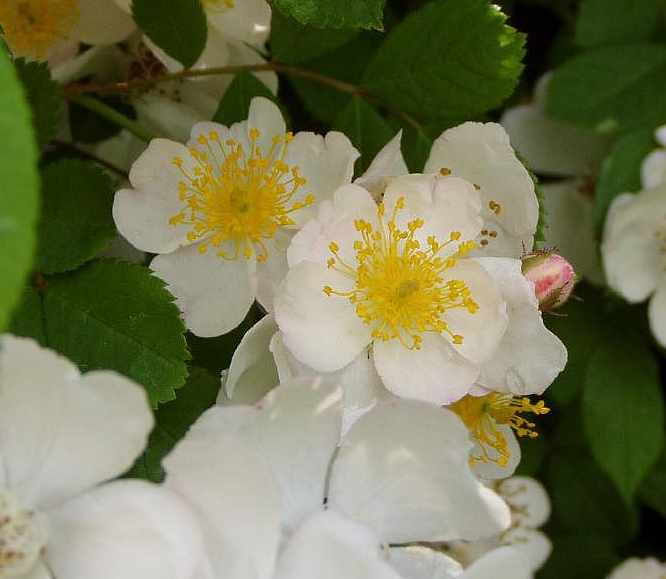
The honey I have is wild rose. Wild rose actually refers to a variety of flowering shrubs including Rosa acicularis, Rosa arkansana, and Rosa virginiana (among others). Unfortunately the Golden Angels Apiary doesn't have a website, and I couldn't find out any more information about their production of their flower sources.


It is a clear, mellow orange-yellow honey with a very thin consistency. I was expecting (and hoping) for a floral rose flavor, but instead got a simple, strong, honey sweetness with no obvious floral or other undertones. Its flavor is consistent throughout with no changes in after taste.It is a good quality honey that offers honest to goodness honey taste. After repeated tastings I think I taste a very subtle molasses-black licorice flavor near the end, but it is VERY subtle and it may just be my imagination. This honey would do well in tea, in baking or anywhere else you need a robust honey taste.


Thursday, August 2, 2012

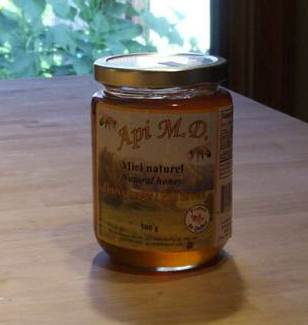
Wildflower honey (fleurs sauvages), Api M.D., Mansonville, Québec, Canada

No visit is complete when we visit my in-laws' cottage on lake Memphramagog in the Eastern Townships of Québec without a walk to Jewett's store. The cottage is in Vale Perkins, which, as far as I can tell, means it is within walking distance of Jewett's. There isn't any semblance of a town or anything called Vale Perkins. There is no sign "entering" Vale Perkins. It is just a dot on a map that corresponds to the crossroads where you'll find Jewett's store. It is too bad the town isn't called Jewett's because then it would be less confusing.

Jewett's is a common name in the region. As you make your way from Mansonville (the closest real town with a post office and everything) to Vale Perkins you pass quite a few farms owned by different Jewett's. I know that when I start seeing wooden signs with the name Jewett's on them I'm not far from the lake or the cottage. 

Jewett's store is a sight to behold and well worth the walk, even on a sweltering, hot day. Although their stock may have changed over the years, the store probably hasn't since before the beginning of time. It is a throwback to dry goods stores in the wild west. The floors are made of weathered wide-planked oak and creak when you walk on them. Shelves line every wall, and every nook is full of something. It is a testimony to efficient use of space. They have it all: from fresh eggs, to local cheeses, cake mixes, snorkels and fireworks. If Jewett's doesn't have it, you probably don't need it.

This past visit, on the road to Vale Perkins, I noticed bee hives (see below). When I did my pilgrimage to Jewett's I asked about them and Ms. Jewett showed me a shelf behind the cash where they stock local honey, saying she had some of it for sale. I picked wild flower. [There were a few other varieties but I'll save them for future visits.]


The apiarist is "Api M.D." and apart from saying the honey is wildflower, a product of Québec and out of Mansonville, the label doesn't give any other information. I searched online to get more but came up empty.

On a hike in the area, I looked for wildflowers. Here is what I found. Don't ask me if I know the names of anything, I don't. On a few flowers I saw honey bees, so it looks like I was in the right place.


The honey itself is a very runny, clear, slightly orange honey. It is very thin and takes a bit of effort to get any to stay on a toothpick long enough to sample. It has a very smooth taste. It is very sweet and has a floral undertone, and then it melts and is gone. There are no complicated flavors, it is just pure throughout. If you need a very runny honey- to spread on something or drip into tea, this is a good choice. The flavor is subtle and may add to an herbal tea (like camomile) but won't overpower whatever you add it to. As far as I know you can only get it at Jewett's store; take note: it is on a shelf, behind the cash in the front.


On this visit to Jewett's I also got another honey from "Cousin Bob" in Ontario (a cousin of the Jewett's who has a bed and breakfast and apiary). In the same time frame I was asked by a fellow blogger, and honey-phile, Elizabeth Gowing if I might like to guest blog on her site. She is an intrepid writer, traveler, beekeeper, and adventurer, and I couldn't say yes to her fast enough (!) She showcases honey and honey recipes and I used Bob's honey (a very good quality table honey) in a comforting tea recipe from Najmieh Batmanglij’s wonderful cookbook “Silk Road Cooking, A Vegetarian Journey.” Check out Elizabeth's blog, 100 days of honey and see my guest blog spot. Be prepared for some exotic honey recipes!