Search This Blog

Tuesday, June 7, 2016

(Heavenly Organics) Neem Honey, Central India

Neem (Azadirachta indica), also known as Nimtree and Indian Lilac, is a drought  and heat resistant tree in the mahogany family (Meliacaea) that is native to tropical and semi-tropical regions. It grows in India, Nepal, Pakistan, Bangladesh, Sri Lanka and Iran, among other places. It can become a large tree (heights up to 40 meters) and one of a few shade-giving trees that thrive in drought-prone areas (e.g. southern districts of India and Pakistan). As a result, it is commonly planted for shade along streets, around temples and in other public places in India. It was exported to other dry areas as a shade tree (e.g. Australia) and has become invasive in some non-native areas. As a result, it has sometimes been classified as a weed. In Australia, for instance, it is illegal to buy, sell or transport Neem plants or seeds, and its spread is actively being controlled.

Neem flowers
The Neem tree has white, fragrant flowers that produce an olive like fruit, which when ripe is half and inch to an inch long and about half an inch wide. The fruit skin is mostly bitter and fibrous, but each fruit contains 2-3 seeds that are the source of Neem oil.

One of the most important uses of neem is as a bio-pesticide. Neem seeds are ground into powder, soaked in water, and sprayed on crops. The neem spray acts as an anti-feedant (substance that adversely affects insects that eat it), insect repellent and egg-laying deterrent. It also suppresses the hatching of insect eggs. In 1962 it was successfully used to protect crops against migratory desert locusts. The anti-insect properties are also found in neem leaves. In India, neem leaves are dried and used as an insect repellent in cupboards and between the folds of clothes, or burnt to keep away mosquitoes.

Neem fruit

Neem has other uses as well. Neem oil has been used in cosmetics, soaps, balms and creams, and as a lubricant. Neem gum is used as a bulking agent in foods. In parts of India, Africa and the Middle East neem twigs (called datum) are used as toothbrushes: if the ends of the twig are chewed they turn into soft bristles that can then be used to clean teeth. Neem cake is used to fertilize crops and protect plant roots from nematodes and white ants. Neem bark is a source of tannin and yields a coarse fiber that is used to make rope.

You can also eat neem (the tender, new shoots and flowers), but it is bitter. Consuming or otherwise using neem leaf, bark and/or flowers is associated with many Hindu festivals. Furthermore, Siddha and Ayurvedic practitioners use neem products medicinally.  In fact, in Sanskrit the word for neem, “Arishtha” means “reliever of sickness.” And there is evidence that neem has medicinal uses. In 1993, a Neem Foundation was established to better understand how Neem might be used. Be aware, though, if consumed in large quantities, neem oil can be toxic.

Neem flowers are also a source of honey. My neem honey is packaged and distributed by Heavenly Organics. Heavenly Organics neem honey comes from the forests of northern and central India and parts of the Himalayan Mountains (e.g. Kashmir, Uttarakhand). It is “wild” honey collected by honey hunters who then sell it to Heavenly Organics. As a result the honey is chemical-free, organic, raw and unheated, maximizing its taste, and enzymatic, vitamin and mineral properties.

wild honey hive
Heavenly Organics is the brain child of Amit Hooda. In 2004, after Mr. Hooda completed his Master’s degree in computer science from the Maharishi University of Management in Fairfield, Iowa, he collaborated with his father and Edward Malloy to create a worker-owned cooperative to foster long-term partnerships that mutually benefit both farmers and consumers. Heavenly Organics is part of the authentic fair trade movement. Mr. Hooda's father, Dr. Ishwar Singh Hooda, is an agronomist and former teacher at Haryana Agriculture University in India. Dr. Hooda has promoted sustainable organic farming methods and sustainable, bee-friendly methods of harvesting wild honey, in rural communities in India for over 35 years. Edward Malloy, the mayor of Fairfield, Iowa, is the US Director of the operation. Currently the cooperative supports nearly 600 family farmers (hoping to expand to 5,000) and produces honey, cane sugar and a variety of different kinds of chocolate honey patties.

Heavenly Organics neem honey
My neem honey has already crystallized in fairly large crystals. It has a caramel, toffee, maple syrup smell about it, and is a warm, toffee color. It has a rich, subtly spicy taste (gingerbread spicy) with hints of caramel, maple syrup and floral tones, and has a slight bitter, smoky after taste. It is a warm, robust tasting honey and would be good on buttered toast, in black tea, baked goods or hot cereal. I got mine at my local Whole Foods supermarket. The Heavenly Organics website has a store locator to help you find it locally as well.

Tuesday, May 24, 2016

Rhododendron honey (mad honey), Apicoltura Cazzola, Altedo, Italy

I'd heard about rhododendron honey ("mad honey") from others but never came across any- so I started looking for it actively and finally found some from Italy online.

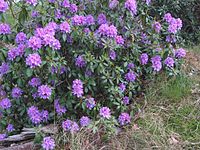
Rhododendron
Why is it so special? In a word, grayanotoxin (i.e. grayanotazane-3,5,6,10,14,16-hexol 14-acetate, named after American botanist Asa Grey). It is a chemical found in rhododendron nectar and pollen that is a neurotoxin, and makes its way into the honey. If ingested, even in small quantities (e.g. less than a teaspoon), it can cause "honey intoxication"- mostly light-headedness. In larger quantities it causes perspiration, hallucinations, and vomiting, among other unpleasant things. If you ingest a bit more it causes severe and progressive muscle weakness and paralysis, breathing difficulties and affects the beating of your heart, which can lead to death. Luckily it is rarely fatal in humans; after a day or two most people recover. This is not always the case for animals though; rhododendron leaves also contain grayanotoxin and (mostly) cattle/sheep/goats (who are not long for this world) like to eat them. So if you have any rhododendron bushes (or azaleas, for that matter- same family) and you have a pet that is attracted to eating their leaves, keep them away.

Honey intoxication - and its use as a weapon- has been well documented. Pliny wrote of how the honey was used against the armies of Xenophon (one of Socrates' students) in 401 BCE. There is also an account of how Roman troops (the army of Pompey the Great) were poisoned by toxic honey - from honeycombs deliberately placed along their route- on their way to fight at Heptakometes in Turkey. I guess the Romans didn't think it suspicious that honeycombs just showed up on their route? Does "too good to be true" come to mind? In the end they were delirious, nauseous and thoroughly sick, and didn't put up much of a fight. If you want to see what a mild intoxication looks like, here is a brief documentary by Raphael Treza "Hallucinogen Honey Hunters" involving a group of men harvesting wild rhododendron honey in Nepal: https://www.youtube.com/watch?v=Y_b2i_FvYPw

Be aware that the toxicity of rhododendron honey varies depending on the amount and type of rhododendron nectar in the final honey; rhododendron varieties differ (significantly) in the quantity of grayanotoxins in their leaves, pollen and nectar. In fact some rhododendrons don't produce any grayanotoxins at all. You may be relieved to know that commonly gardened rhododendrons in North America generally have only small amounts of toxin- not enough to render honey super toxic, but if you eat enough of their leaves you may still be quite sick. In fact, one account I read went so far as to caution against using rhododendron twigs to roast marshmallows. So beware!

Rhododendron forest in Ireland
"Pure" toxic rhododendron honey requires large concentrations of rhododendrons that contain grayanotoxins. In addition, the bee population must be adapted to harvest the toxic nectar and pollen without it killing the hive. This all adds up to only a few places that are well known for producing toxic rhododendron honey: the Black Sea region of Turkey (where the honey is known as deli bal), parts of Nepal and the Reunion Island. Not surprisingly, Rhododendron ponticum, a common wild shrub from the Black Sea region, is the most toxic rhododendron (followed by Rhododendron luteum- another resident of Asia Minor).

While I looked for Black Sea rhododendron honey online, I didn't find any. Mine comes from Italy, from the Cazzola Apiary. Given its origins, I suspect it may not be as toxic as Black Sea rhododendron honey, but even so, there are no warning labels or even information about potential toxicity. This brings to mind a report I read that stated that most European cases of honey toxicity are in tourists who bring back honey souvenirs (unlabeled with regard to toxicity) from Turkey.

Altedo, Italy- near Bologna
The Cazzola apiary, where my honey is from, is a family affair that started when two brothers bought a few hives to pollinate local orchards. They now have over 200 hives and produce a variety of single source honeys by "nomadically following blooms." They are located in Altedo, a small town in the Po Valley, which is 7 km from Malabergo and 23 km from Bologna. It is a fertile agricultural area, particularly known for its green asparagus (they have a yearly asparagus festival in Altedo in May). I didn't see any hint of large swaths of rhododendrons in the area, though. I did see that other apiarists harvested rhododendron honey in the Italian Alps, so I suspect that the nomadic hives of the Cazzola apiary may travel north now and again.

rhododendron honey
The rhododendron honey I have is a mellow, mustard brown color and it has already crystallized. It has a heady smell of summer honey, floral with a hint of the bitterness of chestnut honey. The crystals are on the large side and melt into a slightly sweet honey with a slight bitter taste, similar to chestnut honey, intermingled with herbal and floral tones- and then it has an aftertaste not unlike watermelon. The watermelon is a bit weird, but definitely there. And yes, even after a small taste from a toothpick swirl, I'm light headed, in the span of less than 5 minutes. It feels like being in the car too long- I'm a little woozy and it is hard to concentrate. It is not a great feeling. I may be a light weight, but if this is what a tiny taste can do, I'm not inclined to have more, even though, taste-wise, it is an interesting and unusual honey!

Tuesday, March 1, 2016

Blackberry honey, The Bee Folks, Mount Airy, MD

The blackberry honey that I have comes from the Bee Folks (MountAiry, MD) and was harvested in the U.S. Pacific Northwest, which isn’t surprising since the bulk of blackberry production in the U.S. happens in Oregon, Washington and California.

Marion Blackberry 
As you may know, blackberries are (yummy) edible fruit produced by a number of species in the Rubus genus, and hybrids between the Rubus and Ideaobatus subgenera. While the taxonomy of blackberries might seem straight forward, it is anything but, particularly at the species level. As far as I can tell this confusion stems from the fact that blackberries can reproduce both sexually (via hybridization of two unrelated plants) and asexually (a.k.a. apomixis). This has led to a situation where the original species that existed centuries ago have intercrossed so much that it is unclear where species lines can be drawn. As a consequence some blackberry species are grouped together into ‘species aggregates.’ So a specific species (say Rubus plicatus) may also be part of a species aggregate and can be referred to by the aggregate name (in this case Rubus fruticosus), resulting in the same plant having two different names. It may be easier just to know that all blackberries are in the Rubus genus, and that there are estimated to be over 375 species.

Black Raspberry
One thing that has always puzzled me is the difference between raspberries and blackberries. I know that traditionally one is red and the other is black, and that the shapes of the fruit are a little different, etc. but there are varieties of raspberries that look a lot like blackberries (e.g. black raspberries). So what is the difference?  You may be surprised to know (I was) that it has to do with the stem (called a torus). If you pick the fruit and the torus stays with the fruit, it is a blackberry. If the stem stays on the plant, leaving a hollow core in the fruit, it is a raspberry. Interesting, no?

Other interesting facts I learned: there are three types of blackberry plants: erect, trailing vines and semi-erect; a “thicket” of blackberry (or raspberry) canes is called a bramble (I actually knew this already); and blackberries and raspberries are called collectively “caneberries.” With all this use of “berries” you’d think that blackberries and raspberries are berries, but in fact, botanically, they are not. They are considered an “aggregate fruit composed of small drupelets.” Although “blackdrupelets” doesn’t really roll off the tongue, does it? And while you may think that caneberry canes have ‘thorns’- those hard structures with sharp ends- they are, in fact, ‘prickles.’ I learned that thorns are derived from shoots (i.e. they arise from a bud and as a result often have a very predictable pattern and are connected to vascular bundles inside), and prickles are derived from the epidermis and as a result can be found anywhere on the plant, are not connected to vascular bundles and can be more easily removed. And in case you are wondering, there is a third category of “hard structures with sharp ends”:  ‘spines’ that are derived from leaves.  Of note, there are blackberry ‘prickle-free’ cultivars with the best known being “Triple Crown.”


Types of Blackberry Plants
Blackberries are native to Europe, northwestern Africa, temperate western and central Asia, and North and South America, and they are relatively hardy. They don’t need specific soil conditions and can tolerate cold. They thrive in ditches, wastelands and vacant lots, but they do best in temperate climes where there is a winter chilling to stimulate flower buds. And lots of things eat blackberry leaves – caterpillars, deer- so they are not without their enemies. Other animals eat their fruit- fox, badgers and small birds- which helps disseminate seeds. Blackberries have been introduced and thrive in non-native areas (e.g. Australia, Chile, New Zealand) where they are considered to be an invasive species.
 
Schematic Showing Primacanes and Floricanes
Blackberries are perennials but it usually takes two years for a cane to produce fruit. In the first year the new stem (called a “primocane”) grows to its full length but does not produce flowers. Then in the second year, the stem doesn’t grow anymore but its lateral buds produce flowering laterals (called a “floricane”).  Floricanes die after they have fruited and new canes replace them, growing from the roots of old canes. Raspberries, in contrast, only take one year with the growth and flowering occurring in the same year. While you might think this is yet another difference between blackberries and raspberries, be aware that there are exceptions (i.e. there are blackberry cultivars that produce fruit in the first year that are called “everbearing”). Blackberry plants can produce fruit for 10-20 years.


Flowers (white or pink) are produced in late spring/early summer, and fruit are produced post pollination, so blackberries are reliant on pollinators (like bees). Conditions that affect pollination (weather, heat, etc.) affect the quantity and quality of fruit. The fruit, which starts out red and then ripens to black (due to their containing anthocyanins), is a good source of fiber, vitamin C and vitamin K. Of interest, the seeds- which may not be a favorite with consumers- are high in omega-3 and -6 fats, protein, and fiber.

Characteristics of Different Cultivars (NWplant.com)
Globally Mexico is the leading producer of blackberries- predominantly now from the cultivar Tupy (or Tupi, a Brazilian cultivar developed in the 1990s) but originally from the cultivar “Brazos” (a cultivar develop in Texas in 1959). In the U.S., Oregon is the leading commercial producer, with about 60% of the crop being the Marion cultivar (an industry standard cultivar that was developed in 1956 and named after Marion county). Of interest, the U.S. is a leader in developing all sorts of blackberry cultivars (now generally through work done by the Department of Agriculture’s Agricultural Research Service (USDA-ARS) in their breeding program in Corvallis, Oregon, but originally pioneered by Luther Burbank, father of the “Phenomenal” and “White” cultivars). The U.S. has a long tradition of being in the blackberry cultivar business. In 1880 Judge Logan introduced the Loganberry, a blackberry-raspberry cultivar that is grouped with blackberries, in California. And George Darrow and Walter Knott (of Knott’s Berry Farm in California) developed the Boysenberry, a prickle-free blackberry-raspberry hybrid cultivar. The Boysenberry was named after Rudolf Boysen, the owner of the farm where the original cultivars came from. In 1905 the Youngberry was developed in Louisiana from crossing Luther Burbank, Phenomenal Berry, and Austin-Mayes Dewberry cultivars. 

Fruit Size Differences: L to R Navaho, Apache, Kiowa
The names of blackberry cultivars read like either a list of synonyms for “black” (e.g. “Black Diamond,” “Black Pearl,” “Nightfall,” and “Obsidian”), Native American tribes (e.g. “Cherokee”, “Choctaw”, “Navaho,”  “Chicasaw,”and ”Apache”), people who were associated with the cultivar (e.g. “Austin-Mayes,”and “Boysenberry”), or qualities of the new cultivar (e.g. “Thornless”, “Ouchita” (very thorny), and “Illini Hardy” (produced at the University of Illinois and cold hardy)). I’m assuming the developer of the cultivar has naming rights, which must be a nice perk after all the work it takes to make it happen.

Blackberry cultivars differ regarding zone hardiness, growth pattern (i.e. erect, semi-erect and trailing), thorn status, fruit size, shape, color, flavor and yield, cane length, and fruit time of ripening.  I’m amazed at the variety. If you are considering growing blackberries it is worth researching all the cultivars that are available! And next time I buy blackberries I’ll pay attention to where they were grown and what cultivar produced them.

Blackberry Honey
The blackberry honey I have is thick and a mellow burnt orange color with a subtle berry aroma. It has classic honey sweetness- but not overly sweet- with undertones of ripe blackberries, especially in the after taste. It brings to mind lazy, hot summer days with the sun beating down and the sound of bees going from flower to flower. This may be as close as you can get to putting summer in a jar. This honey would be very tasty in tea, in hot cereal, on hot buttered toast, or right out of the jar. 


Monday, February 1, 2016

Brazilian Pepper honey, The Bee Folk, Mount Airy, MD


The Brazilian Pepper (Schinus terebinthifolia), also known as Hawaiian Christmas Berry, Florida Holly, Rose Pepper, and Broadleaved Pepper, is a sprawling shrub or small tree in the sumac family, Anacardiaceae, which also includes poison ivy, poison oak, poison sumac and poisonwood. As a member of the Schinus genus it is known as a “pepper tree,” although it is not a true pepper. Even so, Schinus molle or the Peruvian Pepper, a close relative of the Brazilian Pepper, is the source of the pink peppercorns that you sometimes see in gourmet pepper mills. The dried berries add a pepper-like taste to food. The Brazilian Pepper is also known as “Hawaiian Christmas Berry” or “Florida Holly” because its red berries mature in December/ January and are sometimes used as Christmas decorations. The “Brazilian” part of its names comes from the fact that it is native to subtropical and tropical South America (i.e. southeastern Brazil, northern Argentina and Paraguay).

Brazilian Pepper berries
The Brazilian Pepper is a dioecious species (i.e. there are both male and female flowers that occur on separate male and female trees) with male flowers lasting one day and female flowers lasting up to a week. Both flower types look the same and are found in abundant clusters. These eventually produce small, red, spherical berries. The shrub/small tree reaches a height of 3-10 meters and has aromatic leaves which when crushed give off a peppery or turpentine-like smell. It is quite a lovely plant to look at and is very popular with bees.

Sometime in the 1840s or 50s the Brazilian Pepper was introduced into the southern U.S. states from South America as an ornamental shrub. The tree adapted very well, actually too well. It is ridiculously hardy and is able to thrive in both dry and wet conditions, can tolerate some salinity and flooding, and, when mature, is also fire-resistant. It is the cockroach of trees- although maybe more attractive. Did I mention that it exudes chemicals in its leaves, flowers and fruit to irritate competing species? It is nearly indestructible and, unfortunately, very invasive. Cold seems to be the only thing that limits it: it is only really happy in hardiness zones 10-12. Interestingly, for about the first 80 years that it was in Florida, it was “controlled” but then in the mid-1920s a horticulture hobbyist gave hundreds of seedlings to friends who planted them in their yards and along city streets. By 1969 it was considered an invasive species of the worst kind, and is now classified as a Category I invasive exotic plant, meaning that it is displacing native species and it should be eradicated whenever possible. It has since taken over large (and ever expanding) areas of Florida, Texas, Arizona, Nevada, Hawaii, Louisiana and California with serious negative impacts on biodiversity. It is causing problems in other places as well: Australia, the Bahamas, and Bermuda, to name a few. In fact, it is such a big problem that the sale, transport or planting of it or its seed is legally prohibited in Florida and Texas (as well as other countries) and the Invasive Species Specialist Group (ISSG) has listed it among the top 100 worst global invasive organisms.
Where the Brazilian Pepper is found in Florida

Unfortunately, it is very difficult to eradicate. This is because if it is cut down it produces basal shoots that produce new trees, it produces lots and lots of seeds that birds (especially migrating robins), mammals (raccoon and possum) and insects (mostly ants) disperse widely, and its seedling survival rate is very high. Mechanical harvesting (down to the roots) and hand-application of herbicides is what is usually needed to get rid of it, with additional follow up treatments if sprouts appear.  Unfortunately, this is all very expensive and difficult to do on a large scale.

Apart from being invasive and having negative impacts on the environment, it also has human health impacts. Its sap can cause skin reactions similar to poison ivy, and eating the berries, which can have a paralyzing effect on some birds, can cause throat irritation, vomiting and gastro-intestinal problems. So, if you grind those lovely pink peppercorns, please be cautious, they are considered to be toxic in large quantities! The Brazilian Pepper is also the source of airborne irritants (especially when in bloom), provoking allergic reactions (e.g. asthma and other respiratory problems) in some. Susceptible people exposed to the tree, even just sitting in its shade, may develop an itching skin rash, face swelling, respiratory problems and other allergy symptoms. Burning the plant makes this worse and being around the smoke (which is described as “noxious”) is like being “maced.” Given how potent it is, it probably is no surprise that the Brazilian Pepper’s leaves, bark, berries, seeds and resin have been used medicinally by indigenous people throughout the tropics for a very long time.

After reading about it, the Brazilian Pepper seems to have only two redeeming qualities: it is an attractive ornamental plant (if you are not allergic to it) and it produces honey. In fact, it is a very efficient producer of nectar (which is by some accounts an unusual fluorescent yellow) and subsequently produces a LOT of honey: approximately 6-8 million pounds in Florida each year. Well, it has one other redeeming quality: given that it typically blooms in late summer into fall (August to November) it is also an important source of nectar for winter honeybee colony maintenance. But that is about it. Everything else about it is pretty bad, at least in areas where it was introduced and is negatively impacting the environment. 

Brazilian Pepper honey
I got my jar of Brazilian Pepper honey online from the Bee Folk. I’m not exactly sure where it originated but my guess is probably Florida since they have the biggest problem with Brazilian Pepper and in the U.S. they produce a lot of its honey. 

According to my readings, Brazilian Pepper honey is by most accounts, too bitter, too peppery, too something else to be table grade, so I think one of the reasons I hadn’t heard of it is that most of it may be sold for commercial use rather than table use. In fact, I’ve read varying accounts of what it tastes like, from sweet potatoes to pepper. This may be partly due to differences in soil and weather conditions, but also due to the honey not being purely from Brazilian Pepper flowers; many apiarists who harvest Brazilian Pepper honey note that while the majority of the honey’s floral source is Brazilian Pepper, other floral sources are involved, and these flavors interact to produce the final flavor. 

I’ve had my honey for a while and it has crystallized, with fairly large granules. It is a mellow orange/brown color. As for flavor, it is not too sweet and has a sweet potato flavor with an overlay of molasses, and then a final, subtle, pepper kick, but definitely more sweet potato than pepper. I didn't find it bitter at all. I'm not sure why it wouldn't be considered for table use, it is quite nice! I think it would be great in baking- and pretty good right out of the jar. 

If you'd like to try some for yourself, you can order some online from the lovely Bee Folk website.

Monday, January 18, 2016

Miel de la Beebliothèque (Library Honey), Westmount, Québec, Canada

Last December we visited my mother in-law who lives in Westmount, Quebec, a western suburb of Montreal, and she gave me a small jar of honey that was produced by her local library, the Westmount library. It turns out that in 2015 the library installed a few hives on their roof and sell honey to raise money. "What on earth are librarians doing keeping bees?" you might ask. Good question. But, in fact, the librarians haven't turned apiarist but rather have enlisted the services of an urban beekeeping service, Alvéole, to install and maintain their hives, and extract honey at the end of the season. 

Westmount Library
 An urban beekeeping service?  Yes. Started in 2012, Alvéole is the brain child of three beekeeping friends, Etienne Lapierre, Alexandre McLean and Declan Rankin. To combat the recent declines in bee populations due to environmental changes, the use of pesticides and new bee parasites and illnesses, the three thought bringing bees to an urban center, like Montreal, might be (part of) the solution. You see, in Montreal there are strict anti-pesticide regulations and an abundance of untapped floral sources. Local hives would produce quality local honey, increase local pollination rates and contribute to making the city greener, as well as protect and harbor bee colonies. Win, win, win.

The idea caught on and there were many takers. By 2015 Alvéole had >70 corporate and private clients across Montreal island and the south shore, and they continue to grow (and have recently expanded into Toronto). What do the Westmount library, Birk's Jewelers, Aldo shoes and the Public Works Office of St. Lambert all have in common? They all have hives on their roofs courtesy of Alvéole.

Westmount park
For about $750 CAN the first year, Alvéole will set everything up, take care of the hives, and extract the honey at the end of the summer. They guarantee 10 kg of honey to the client and keep the rest, which they sell in their store and on-line. The honey is 100% pure, filtered and unpasteurized. Given that each hive produces about 15-20 kg of honey per year, there is plenty of honey to go around.  Under the Alvéole label, they sell honey by Montreal island region: Villeray, Sud-Ouest, Plateau, NDG Westmount. The different floral sources of each region give each a unique taste and texture. And apart from honey, Alvéole also sells lip balm, soap, totes and a yearly calendar featuring nude apiarists! Check out their on-line boutique.

Westmount library was founded in 1897 in commemoration of Queen Victoria's Diamond Jubilee, and two years later, the grand Victorian building that has housed it for all these years was built in 1899. The library is adjacent to Westmount park, a verdant oasis of trees, flowers and water features. I can't think of a better place for hives. 

Miel de la Beebliothèque (Library honey)
The name of the miel de la Beebliothèque is a play on words of the French word for library, 'bibliothèque.' 

The honey is very light yellow and clear, but quite thick. It is not too sweet and has a floral first taste with a strong menthol herbal after taste. It makes me wonder if their are any eucalyptus trees in the park. Next time I visit I'll have a look around. It is very tasty, and would be great drizzled on plain yogurt or on hot, buttered toast, and in a strong cup of black tea. If you are in Montreal, head to the Westmount library on Sherbrooke street to check out their honey (while supplies last), or go to the Alvéole store at 5425-217 Rue de Bordeaux for Montreal island honey and ask for the NDG Westmount region, or save yourself the trip(s) and check out the online boutique.


Friday, December 11, 2015

Basswood (Linden or Lime) Honey, The Bee Folks, Mount Airy, MD


I wasn’t familiar with basswood honey before I saw and bought it on the Bee Folks (lovely) website. The Bee Folks started in 1997 as a back yard operation in a suburb of Baltimore. In 2004 they moved to Poplar Springs on the outskirts of Mount Airy, Maryland where they expanded their operation. They continue to be a small, family owned and operated company that produces and distributes a variety of high quality, and not so easy to find, honey. I've blogged about a few of their honeys (see entries for Carrot, Cotton, Almond and Radish honeys) and have always found the quality to be great.

Not surprisingly the floral source for basswood honey is the blossoms of the basswood tree. However, I had never heard of the basswood tree. In fact, it is also, and probably better known as, the linden tree. I've heard (and can identify) a linden tree. Going forward I’ll refer to the tree as “linden” since it is more commonly known this way. There are about 30 varieties of linden trees, all within the Tilia species.

Tilia americana
(American Linden or Basswood tree)
Since my basswood honey is from the US it is likely to be from Tilia americana (the second likely candidate is Tilia heterophylla). Tilia americana is native to eastern North America (from Manitoba to New Brunswick, south to northern Texas to South Carolina, and west to Nebraska. Of interest, Tilia americana is known for being one of the most difficult native North American trees to propagate from seed, with only 30% of all seeds being viable. Thankfully, the tree often relies on self-coppicing (i.e. propagation via new growths emanating via shoots and sprouts  from stumps), to propagate rather than by seeds. 


The honey is called “basswood” or “linden” honey in North America, and “lime” honey in the UK and Europe. Basswood is derived from “bast” the name for the inner fibrous bark of the tree (incidentally used by the Ainu people of Japan to weave their traditional clothing, the attus, and also used in basket and mat weaving). One of the Linden species common in Europe (and parts of Russia and China) is the Tilia cordata, a small-leaved variety that is also called “Lime,” hence “Lime” honey.  “Lime” is apparently an altered form of Middle English “lind.” This Tilia is not related to the lime fruit or lime trees (Citrus aurantifolia). This, to me, makes referring to Tilia honey as "Lime" honey very confusing!


The native range of Tilia Americana (from:
http://www.na.fs.fed.us/spfo/pubs/silvics_manual/
volume_2/tilia/americana.htm

Bees love Tilia blossoms. The tiny, yellow-white flowers bloom in clusters (i.e. drooping inflorescences) and exude a fragrant aroma that has been described as “ambrosial.” Ants and aphids also love this tree because of its rich supply of sap. They “farm” the sap, which does not seem to cause any serious damage to the tree, leaving a syrupy honeydew residue on anything (e.g. a car) below the tree (so be warned). 

At the peak of the season (late spring to mid-summer) the blossoms produce so much nectar that it can be seen as a shiny deposit on the blooms. Bees swarm the trees during this time giving the linden tree the informal name of “bee” tree.


Tilia Americana blossoms
Linden trees are long-lived (possible lifespan of up to 2,000 years for some species!), tall (20-40 meters), handsome trees with a dense head of abundant foliage that have often been planted in European town centers or along city streets. One of the oldest known linden trees, estimated to be 2,000 years old, can be found in the Westonbirt Arboretum in Gloucestershire. Empress Cunigunde, the wife of Henry II, planted a linden tree in 1,000 A.D. in the courtyard of the Imperial Castle at Nuremberg that is still alive and well. In addition an 850 year old linden tree, the Rut linden tree, is found in Slovenia beside a church in the mountain village of Rut. The Tilia americana, however, is generally not so long-lived with a lifespan of up to 200 years.

Linden trees have been mentioned in many ancient texts. Pliny the Elder (A.D. 23 to A.D. 79) wrote about them. There is also a Roman myth about Baucis and Philemon who were granted eternity together as a linden and an oak tree (see the lovely painting by GC Myers depicting the lovers in their intertwined tree-ness).

Baucis & Philemon by GC Myers
http://redtreetimes.com/


Linden timber is soft and easily worked, and used for furniture making, model building and carving. It was one of the classic woods for sculpture in the Middle Ages (e.g. altarpieces) and for puppet-making. Given its acoustic properties it is also used for making instruments (e.g. bodies for wind instruments and solid body electric guitars). Of interest it was often used by Germanic tribes for making shields. Unfortunately, in the U.S., due to the destruction of softwood forests for the furniture industry, basswood/linden stands are not as common as they once were making this honey sometimes hard to find.
Linden honey has been used medicinally. In hot tea or in lemon juice it has been used to treat colds and laryngitis, and sooth sore throats. It has also been used to treat minor skin sores and burns, and eczema topically. Linden flowers can be used to make an herbal tea, and also to treat colds, cough and fevers. Of interest the flowers have been added to hot bath water to “quell hysteria.”

basswood (linden) honey
Linden honey, no matter from what type of linden tree, is reported to taste pretty much the same. When very fresh it has a greenish color, but can range from clear to amber. My honey is more on the amber spectrum. I can't detect much of a smell, although I've seen its aroma described elsewhere as "woody." It is medium thickness, clear and smooth. It isn't overly sweet and the taste, a fresh, citrus, menthol, camphor taste, is consistent throughout. It reminds me slightly of a lemon/lime flavored cough drop. The aftertaste is slightly acidic/bitter, sort of lemony/limey. I can see why some describe the flavor as "green." I think basswood/linden honey would go well in hot cereal, on hot buttered toast, or in hot tea. I've heard that it goes nicely with Earl Grey tea and would agree. The bergamot of the tea and citrus of the honey would be complementary.  

While I got my honey on The Bee Folk website, I see that they no longer have it available. I'm hoping this is a temporary situation. In any case it is a reminder that if you see a honey that is a bit unusual you should take advantage!